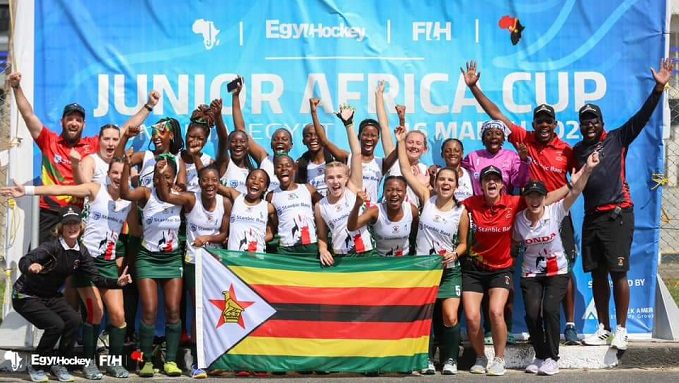
Zimbabwe U-21 women’s hockey coach Brad Heuer set the tone for his side’s journey to the 2025 Women’s FIH Hockey Junior World Cup. For him and his players, the upcoming tournament in Santiago, Chile, is not just a competition. It is a statement.
The event runs from December 1 to 13, bringing together 24 of the world’s best junior sides. Zimbabwe will line up alongside continental rivals South Africa and Namibia, carrying the hopes of a nation eager to be noticed on the world stage. Three months out, the commitment is visible everywhere.
On the pitch, players grind through drills, pushing fitness and tactical sharpness. Off the field, administrators from the Hockey Association of Zimbabwe (HAZ) scramble to secure funding and logistics.
“Our preparations have been going on really well,” said team media representative Tafadzwa Makamure. “The team is training hard, finalising our fitness and tactical preparations.”
But preparation has its costs.
“One of our biggest challenges is funding. Getting a team to a world-class tournament like the Junior World Cup is a huge financial commitment,” Makamure explained.
“We are working tirelessly to raise resources for travel, accommodation and equipment. The support from well-wishers has been incredible so far.”
While fundraising continues, the players juggle their own challenges.
Schoolwork, family duties and the demands of elite training rarely align.
“We have a challenge in balancing training with the girls’ school and personal commitments,” Makamure admitted.
“The good thing is that the girls are dedicated and inspired. They show up, work hard and never lose sight of the dream.”
Dedication has long defined this side.
Zimbabwe’s U-21 women have now qualified for four of the last five Junior World Cups, in 2016, 2022, 2023 and again in 2025. For a team from a country where hockey battles for attention and resources, that consistency speaks volumes.
The Chile tournament is not only about results. For Zimbabwe, it is a measure of progress. “Zimbabwe is still work in progress, but we view that as a positive,” said Makamure. “Each tournament gives us the opportunity to measure ourselves against stronger teams, gain valuable experience and continue closing the gap.” That view is shared at Government level. Deputy Minister of Sport, Recreation, Arts and Culture Emily Jesaya has pledged support, saying on HAZ’s social media platforms: “The ministry is committed to supporting you as you prepare for the Junior World Cup in Chile. I look forward to working with you.”
As December draws closer, the narrative is no longer just about sport. It is about young athletes carrying the weight of a country’s pride, backed by coaches and administrators who refuse to let financial obstacles dull their ambition.
For Heuer and his players, the road to Santiago is proof of what can be achieved when passion outpaces resources.
The final whistle in Chile will decide results, but the story of Zimbabwe’s junior women has already been written: one of grit, inspiration and a nation’s belief in its girls.