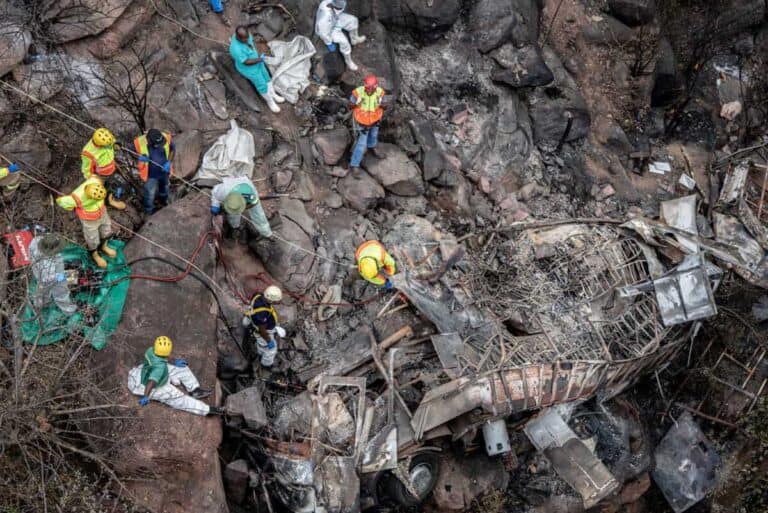
Survivors of the horrific Limpopo bus crash that claimed 42 lives say the tragedy was a disaster waiting to happen — with several warning signs ignored along the way.
Chaoma Mukondiona, 25, from Mashonaland in Zimbabwe, said moments before the deadly crash, the driver had been speeding and had narrowly avoided a head-on collision.
“I saw it with my own eyes. The bus was travelling at high speed and he was getting into a head-on collision but managed to control the bus,” said Mukondiona.
Passengers were left shaken and scolded the driver, pleading with him to drive safely.
“You must drive carefully, we don’t want trouble,” Mukondiona recalled passengers shouting.
Mukondiona had boarded the bus in East London, Eastern Cape, on his way home for important family matters, including an exam and a traditional ceremony for his late grandfather. But the bus was overcrowded, and Mukondiona, unable to find a seat, slept on the floor in the aisle.
“It is a miracle to be found alive while others died,” he said from his hospital bed. “The last thing I remember before falling asleep was that the bus was travelling at high speed. Then I woke up in hospital. I was terrified.”
Over 90 passengers were on board when the bus overturned along a mountainous stretch of the N1 near Louis Trichardt. Forty-two people were killed, while 49 were rushed to hospital.
Limpopo Premier Dr. Phophi Ramathuba’s spokesperson, Thilivhali Muavha, confirmed that the bus was transporting passengers from Zimbabwe and Malawi, who were travelling from the Eastern Cape to their home countries when it veered off the road and plunged down an embankment.
Mukondiona, who works at a poultry factory in Mthatha, said he had been reluctant to board when he saw the overcrowded bus, but felt he had no choice.
“I had important things to do at home,” he said. He lost his academic certificates, R2,500 in cash, and clothes he had bought for his parents in the crash.
Another survivor, Willard Suweni from Machinga, Malawi, echoed Mukondiona’s account, describing reckless driving and serious mechanical concerns.
Suweni said he overheard the two drivers discussing brake problems and complaining that the overloaded trailer should be removed — a warning that went unheeded. He boarded the bus in Gqeberha.
“The trailer was never removed and the journey continued,” he said.
He added that the driving was relatively smooth until they reached Bloemfontein, where the driver began speeding dangerously.
“Please, try to slow down. We have small children,” Suweni recalled passengers pleading.
But the driver did not slow down. As they approached Limpopo, Suweni said the driver took a bend so fast that it left everyone silent in fear.
“No one could talk at that point,” he said.
Suweni, a farmworker in South Africa, was returning home to see his wife and three children for the first time in four years. He had bought them cellphones, shoes, and clothes — all of which were lost in the crash.
He was set to disembark in Harare and catch another bus to Blantyre, Malawi. But after surviving the crash, Suweni said he has decided to stay home for good.
“I don’t know how I got out, it could only be God,” he said, visibly shaken. “There was a guy from Zimbabwe behind me, with his wife and small daughter. Another man had his wife and child too. They are all dead.”
He added that many children on board lost their parents in the crash.
Despite multiple attempts, Sowetan was unable to reach DNC Coaches, the company that owns the bus. Calls went unanswered and messages received no response.
While investigations are still underway, Premier Ramathuba — who visited the crash site — said fatigue may have also played a role in the crash.
As survivors struggle to come to terms with the tragedy, many are calling for urgent accountability and better enforcement of road safety regulations to prevent such devastating incidents in the future.