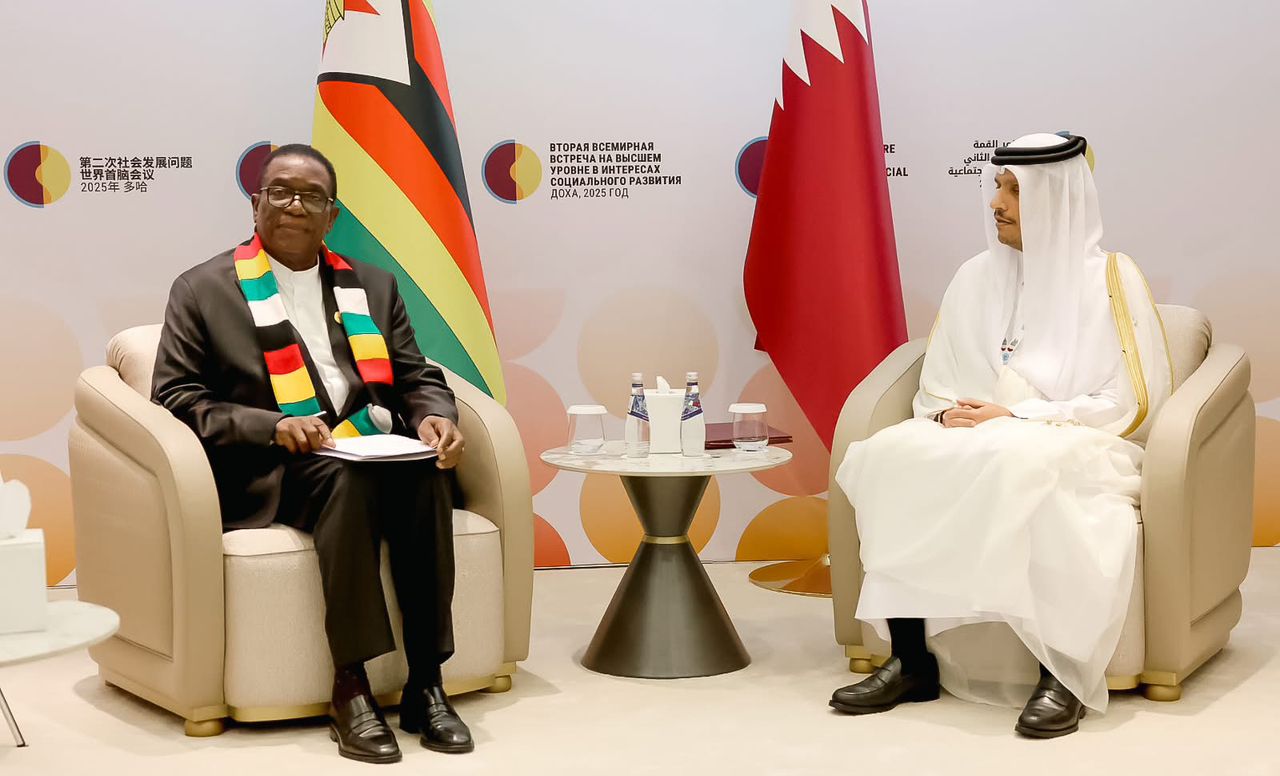
Doha, Qatar — In a significant diplomatic engagement aimed at strengthening ties between Harare and Doha, the President of the Republic of Zimbabwe, His Excellency Dr. Emmerson Dambudzo Mnangagwa, yesterday held a closed-door bilateral meeting with the Prime Minister and Minister of Foreign Affairs of the State of Qatar, His Excellency Sheikh Mohammed Bin Abdulrahman Al-Thani.
The meeting took place on the sidelines of the ongoing Second World Summit on Social Development in Doha and underscored Zimbabwe’s expanding diplomatic outreach in the Gulf region. The discussions reflected both nations’ commitment to forging new alliances anchored on mutual respect, shared interests, and economic cooperation.
According to sources within the Zimbabwean delegation, the talks were held in an atmosphere of warmth and mutual understanding. The two leaders reaffirmed their commitment to building a long-term partnership aligned with the development aspirations of both Zimbabwe and Qatar.
Focus on Economic Cooperation
The bilateral discussions covered a broad range of issues, including investment opportunities and strategic cooperation in key sectors such as energy, agriculture, tourism, mining, and infrastructure development.
President Mnangagwa’s engagement with Qatar — one of the wealthiest and most strategically positioned nations in the Gulf — comes as Zimbabwe intensifies its “Engagement and Re-engagement Policy.” The policy seeks to strengthen ties with traditional allies while cultivating new partnerships, particularly across Asia and the Middle East.
Consistent with his “Zimbabwe is Open for Business” mantra, President Mnangagwa emphasized the importance of attracting foreign investment as a key driver of Zimbabwe’s economic revival. Both leaders discussed ways to enhance trade relations and diversify economic cooperation beyond traditional sectors.
Opportunities for Investment
Zimbabwe, endowed with abundant natural resources such as gold, platinum, lithium, and diamonds, offers significant investment prospects that could benefit from Qatar’s financial and technological strength.
In addition, the country’s strong agricultural base provides fertile ground for cooperation in food security and agricultural exports — areas of interest for Qatar, which continues to invest abroad to secure sustainable food supply chains.
Energy cooperation also featured prominently in the talks, with discussions focusing on renewable energy, gas, and petroleum development. Zimbabwe’s ongoing efforts to diversify its energy mix through expanded solar and hydroelectric projects align with Qatar’s expertise in global energy production and management.
Collaboration in Tourism, Education, and Innovation
Tourism and hospitality were identified as vital sectors for mutual collaboration. Zimbabwe, home to Victoria Falls, one of the Seven Natural Wonders of the World, is seeking Qatari investment in tourism and real estate. In turn, Qatar’s success as a global travel and sports destination offers valuable insights and opportunities to help modernize Zimbabwe’s tourism infrastructure.
The leaders also explored cooperation in education, innovation, and technology transfer, recognizing these as critical areas for capacity building and youth empowerment. President Mnangagwa reiterated his Government’s vision to transform Zimbabwe into a modern, industrialized, and knowledge-driven economy by 2030, a goal that could be greatly enhanced through partnerships with technologically advanced nations like Qatar.
Commitment to Sustainable Development
The bilateral meeting took place within the broader framework of the Second World Summit on Social Development, which brings together world leaders, policymakers, and experts to advance inclusive growth, poverty eradication, and sustainable development.
Both President Mnangagwa and Prime Minister Al-Thani reaffirmed their shared commitment to promoting global social justice, human development, and the empowerment of marginalized communities.
The leaders emphasized the importance of aligning bilateral cooperation with the United Nations Sustainable Development Agenda 2030, which prioritizes equitable access to education, healthcare, and employment opportunities for all.