Across the sandy plains and forested edges of Tsholotsho, a quiet but powerful cultural revival is taking place. The San community—Zimbabwe’s earliest inhabitants and among the world’s most ancient cultural groups—is making determined efforts to save its language and heritage from extinction. At the heart of this effort stands Tsoro-o-otso San Development Trust director, Davy Ndlovu, whose tireless work has become a beacon of hope for a community long pushed to the margins of national consciousness.
Language loss is not merely a linguistic issue; it signifies the disappearance of worldviews, histories, knowledge systems, and identities. The San language, Tjwao, once spoken widely across various communities, is today on the brink of collapse. Fewer than ten native speakers remain, most of them elderly, representing the fragile last thread connecting the present generation to their ancestral voice. Despite its official recognition in Zimbabwe’s Constitution, the language has been overshadowed by more dominant tongues like isiNdebele and TjiKalanga, which many in the community have adopted out of necessity.
It is against this backdrop that Ndlovu and his team launched the San Community Organised Rebirth Event (SCORE), a project aimed at fostering a cultural and linguistic rebirth. Through activities such as bush camps, language lessons, and intergenerational cultural exchanges, the initiative is deliberately rebuilding the foundation of Tjwao within the San community.
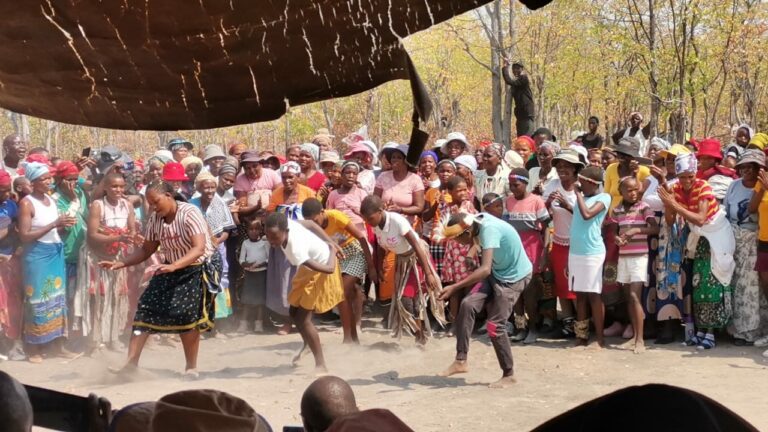
The bush camps, in particular, have become living classrooms. Villagers gather to participate in traditional activities—lessons on hunting expeditions, discussions on marriage customs, and community storytelling sessions. Conversations begin in isiNdebele before being translated into Tjwao, helping participants relearn vocabulary and embrace pronunciation patterns that have long been dormant. Working hand-in-hand with the last generation of fluent speakers, the project is strengthening the fragile bridge between past and present.
Preserving the San language is vital for several reasons. First, languages carry the ecological knowledge of communities deeply attuned to their environments. The San people, with their intricate understanding of the land—its plants, animals, weather patterns, and survival techniques—hold knowledge systems that could enrich Zimbabwe’s ecological and climate resilience strategies. Losing Tjwao would mean losing this repository of local wisdom.
Secondly, language is a central pillar of identity. Reviving Tjwao becomes an act of empowerment—an assertion of dignity and cultural autonomy. Through SCORE, the community is reclaiming its story and reaffirming its identity in a rapidly changing world.
Thirdly, language preservation is a global issue. Linguists estimate that half of the world’s 6,500 languages could disappear by the end of this century. Already, around 400 languages have vanished over the past century—an alarming rate of erosion. Each language lost diminishes humanity’s cultural diversity, erases histories, and narrows the scope of human expression. In this context, Zimbabwe’s efforts to save Tjwao are part of a broader, global struggle to maintain linguistic diversity as a critical component of human heritage.
One significant and forward-looking aspect of the preservation work is the push to develop educational materials and written records in Tjwao. Producing books in the language is not merely symbolic; it lays the foundation for long-term preservation. Written materials ensure that the language can be taught in schools, archived, studied academically, and used officially within the community. They turn oral heritage into documented knowledge, bridging generations and safeguarding the language from future loss.
The involvement of institutions such as the Curriculum Development Unit (CDU) and other minority rights groups is an encouraging sign. Their support helps situate the San language within national education and heritage frameworks, ensuring that the preservation effort transcends community-level activism and becomes part of Zimbabwe’s broader cultural policy.
Communities across Tsholotsho—Gariya, Mtshina, Gulalikabili, Sanqinyana, Sakhile and others—are participating in this cultural return. Their willingness to take part in language sessions, cultural gatherings, and bush camps reflects a collective desire to embrace identity and rebuild cultural pride. It is particularly encouraging that young people are showing interest, for without them any preservation effort is merely temporary.
Zimbabwe stands to benefit enormously from recognising and nurturing the diversity inherent in its indigenous languages. Supporting minority languages fosters inclusivity, strengthens social cohesion, and enriches the national heritage. A country’s cultural strength lies not only in its major languages and traditions but also in the survival of its smaller, older, and often more vulnerable cultural identities.
The work being led by Ndlovu and the Tsoro-o-otso San Development Trust deserves national recognition. In a world where endangered languages often disappear silently and without intervention, their commitment is a powerful example of grassroots activism, cultural stewardship, and community resilience. Their effort not only preserves a language but also celebrates Zimbabwe’s heritage in its fullest, most authentic form.
As the San community continues its journey of linguistic rebirth, the nation must support and amplify this work. Preserving Tjwao is not simply about saving words—it is about honouring a people, safeguarding ancient knowledge, and affirming that every culture, no matter its size, has a rightful place in the story of Zimbabwe.