Once synonymous with discipline, prestige and academic success, single-sex schools are gradually losing their grip on parental preference. As Zimbabwean families rethink what education should deliver, co-educational schools are emerging as the favored choice, praised for fostering social skills, collaboration and mutual respect in a world where gender integration is unavoidable.
For generations, Zimbabwe’s elite single-sex boarding schools were seen as the gold standard of academic excellence. But a quiet shift seems to be underway as parents are convinced that learning alongside both boys and girls better prepares children not just to pass examinations, but to navigate life beyond the classroom, in turn breaking the tradition of once preferred and renowned single-sex schools … talk of St Ignatius, Kutama, Marist Brothers, Regina Mundi, St Dominics, Monte Cassino!
This trend reflects not just changing societal attitudes, but a recognition that socialisation, collaboration, and mutual respect between genders are essential components of a well-rounded education. For it seems that several of the country’s historically single-sex schools have responded to this shift by opening their doors to both sexes.
Recently, St George’s College in Harare, once an exclusively boys school, this January started admitting girls for form one, building on its earlier inclusion of girls in lower six, in 2020. Falcon College in Esigodini, originally a boys’ boarding school, began enrolling girls in 2016, creating a fully co-educational campus. Other institutions, over the years have been doing likewise, talk of Plumtree High School, Fletcher High School in Gweru, and Embakwe High School, have similarly embraced co-education, while former girls’ schools such as Minda High School and Usher High School have begun accepting male students.
So, what does this suggest?
This movement towards co-education is more than a response to declining enrolments or the practicalities of maintaining infrastructure. Rather, it signals a broader recognition that schools must reflect the realities of contemporary Zimbabwean society, equipping young people with the skills and experiences necessary to thrive in a world where cooperation across genders is the norm rather than the exception.
For generations, Zimbabwe’s boys and girls schools were not just educational institutions but cultural icons…symbols of tradition, discipline, and academic excellence. They carried legacies, histories, and alumni networks that inspired pride in families and communities alike. Yet today, the very factors that once underpinned their appeal are being challenged by shifting parental preferences, practical realities, and demographic changes.
One educationalist opined that one of the most immediate drivers of this transition is declining enrolment numbers, as the country has seen the emergence of private schools, breeding competition to the traditional prestigious single-sex schools.
He added that many former single-sex boarding schools, have been struggling to attract enough pupils to remain viable as gender-exclusive institutions. Hence by opening admission to both boys and girls, schools can fully utilise their infrastructure, increase student numbers, and enhance financial sustainability. This is not a compromise but a strategic evolution that ensures these storied institutions continue to thrive and provide quality education.
However, beyond logistics, there is a growing belief among parents and educators that co-educational environments better prepare students for life beyond the classroom.
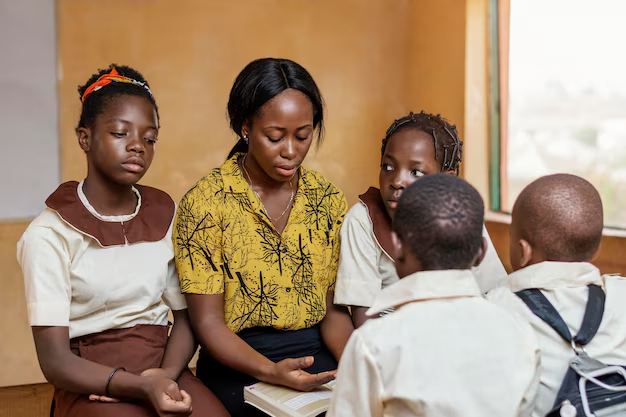
Zimbabwe’s workplaces, universities, and communities are inherently mixed-gender spaces where boys and girls interact daily. As such schools that mirror this reality help students learn how to socialise, collaborate, and compete respectfully across genders,skills increasingly valued in modern society.
In co-educational schools, students develop empathy, communication skills, and an understanding of different perspectives, all while gaining confidence in mixed-gender interactions.
The move toward co-education is not purely pragmatic; it also reflects changing societal attitudes about gender and education. Today’s learners and their parents expect schools to reflect inclusivity, diversity, and fairness. They want environments that build empathy, mutual respect, and interpersonal skills. Mixed schools naturally provide these opportunities, offering classroom discussions enriched by diverse viewpoints and extracurricular activities that foster teamwork and leadership in mixed-gender settings.
Institutions such as St George’s College and Falcon College illustrate this shift. The schools’ decision to embrace co-education should not be taken lightly, for they represent deliberate, strategic responses to evolving parental demands and societal change.
Another often reluctantly spoken of issue has been homosexuality which most some parents believe could breed from single-sex schools as children will still be emotional vulnerable, going through adolescence and still trying to discover themselves. Some claim that this developmental stage, coupled with an unrealistic world of interacting with just one sex, which is not reflective of the world’s realities might eventually confuse the child.
Critics of co-education often argue that single-sex schools provide tailored environments where students can focus solely on academics without the distractions of social dynamics between genders.
Supporters highlight advantages such as enhanced confidence, leadership development, and the ability to pursue subjects without traditional gender pressures. Study has proven that girls in single-sex schools, are often more likely to take STEM subjects, while boys may explore the arts without concern for societal judgment. Likewise teachers can also adapt their methods to suit the learning styles of a single gender, and students may thrive academically in these focused environments.
Yet these benefits must be weighed against the realities of parental choice, social integration, and long-term relevance. Single-sex schools may limit students’ exposure to the opposite sex, potentially creating challenges when they enter mixed-gender universities, workplaces, or communities. They may also inadvertently reinforce gender stereotypes and offer fewer opportunities for social diversity and team-based learning in mixed-gender contexts.
But is this what the country needs right now, bearing in mind that we now in the twenty first century were the global village continues to channel out gender recognition and equality based on competence not one’s sex.
In comparison, mixed schools prepare students for the real world, an environment where collaboration across genders is unavoidable and essential.
Ultimately, the choice between single-sex and mixed education depends on what parents value most. Are they seeking a focused, gender-specific environment that nurtures confidence, leadership, and concentration? Or are they prioritising real-world preparation, social integration, and a more inclusive approach to learning? Well, the truth is that both models have merit, and there is no one-size-fits-all answer.
However, in an increasingly interconnected and dynamic society, the trend towards co-education reflects not only parental preference but also the need for schools to remain relevant, adaptive, and responsive to the world outside their gates.
For parents navigating this decision, the advice is clear: consider the whole child, that is academic, social, and emotional development. Examine the school’s culture, teaching philosophy, extracurricular offerings, and ability to prepare students for life beyond the classroom.
A school that offers academic excellence but fails to develop social competence may leave students ill-prepared for the realities of modern Zimbabwean society. Conversely, a school that balances academic rigor with social inclusivity is equipping young people for success in every arena of life.
The shift towards co-education is not the death of tradition; it is an evolution of Zimbabwe’s education system, ensuring that schools remain vibrant, sustainable, and capable of nurturing the next generation.
In the end, Zimbabwean parents must make decisions with both vision and pragmatism. Whether choosing a single-sex school or a co-educational one, the goal is the same: to provide children with an education that prepares them to thrive academically, socially, and emotionally, in a world where collaboration, empathy, and adaptability are just as important as knowledge and discipline.
In a country in transition, the best schools will be those that balance tradition with modernity, focus with inclusivity, and academic excellence with social preparation.
The conversation is ongoing, but one thing is certain: Zimbabwe’s educational landscape is evolving, and parents have a pivotal role in guiding their children toward environments that will prepare them not just for exams, but for life itself!