Minister of Foreign Affairs and International Trade, Professor Amon Murwira, yesterday told the World Economic Forum in Davos, Switzerland, that Africa must urgently embrace nuclear energy to overcome worsening power shortages that are undermining industrialisation
Speaking during a high-level panel on Africa’s energy future, Prof Murwira said the continent’s development prospects are inseparable from its ability to generate sufficient, reliable and affordable power at scale.
“The dream of an industrialised Africa can only be met with the capacity to produce enough energy. Without that capacity, industrialisation remains an aspiration rather than a reality,” he said.
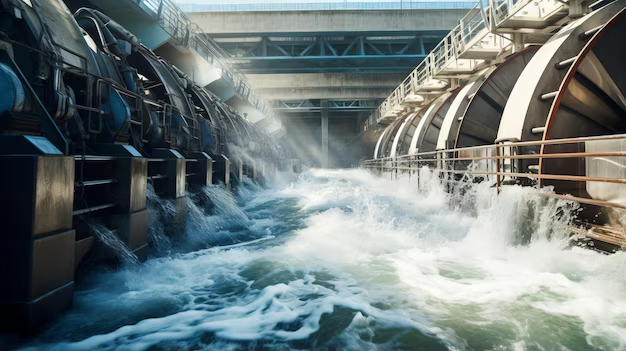
He said Africa’s current energy model has been severely tested, particularly in Southern Africa, where countries such as Zimbabwe and Zambia have relied heavily on hydropower.
“Over the past five years, recurring droughts have reduced hydropower generation to as low as nine percent of installed capacity.
“With climate projections indicating droughts every five to ten years, it is clear that hydropower alone can no longer anchor our national energy systems,” Prof Murwira added.
Prof Murwira supposed that these realities were forcing African countries to rethink long-held reservations about nuclear energy.
“What was once approached with hesitation is now increasingly viewed as a viable and necessary option.
“Egypt is building its first nuclear power plant, South Africa is extending the life of its reactors while planning new capacity, and more than a dozen African countries are laying the groundwork for nuclear programmes,” he said.
He said Africa’s strategic importance in the global nuclear landscape cannot be ignored.
“Africa holds about 14 percent of the world’s known uranium resources. This gives the continent a critical role, not just as a consumer of energy technologies, but as a key stakeholder in the global energy transition,” Prof Murwira noted.
He however cautioned that nuclear energy requires long-term planning and serious investment.
“Nuclear energy is not quick and it is not simple. Even a small nuclear programme requires between 50 and 100 highly trained scientists and engineers, as well as sustained investment in education, regulation, grid stability and waste management,” he said.
Prof Murwira advanced that technological advances are nonetheless opening new possibilities for Africa.
“Small Modular Reactors offer flexible and scalable solutions that are better suited to African grids. They come with lower upfront costs and reduced financial risk, which is critical for developing economies,” he said.
With support from the International Atomic Energy Agency and growing cooperation with global financial institutions, Prof Murwira said Africa’s nuclear future is becoming increasingly realistic.
“Atomic energy is not a silver bullet, but without it, Africa’s industrial transformation will remain constrained,” he said.
Nuclear energy has gained renewed attention in Africa as climate-induced droughts continue to undermine hydropower generation, which remains a major electricity source in several countries, including Zimbabwe.