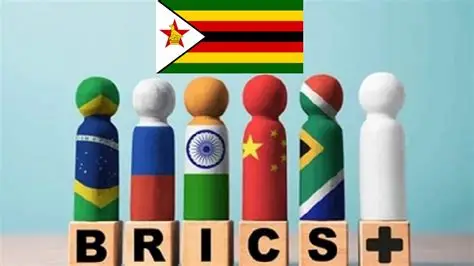
Zimbabwe has intensified its diplomatic campaign to secure membership in the BRICS economic bloc, as Government steps up engagement with member states in a bid to diversify international partnerships and strengthen its global influence.
The renewed push comes amid heightened geopolitical uncertainty, with countries across the Global South increasingly pursuing alternative alliances to counterbalance Western-dominated financial and political. It also coincides with widening fractures within traditional western power blocs, reshaping the post-World War II global order.
In an interview with the media yesterday, Minister of Foreign Affairs and International Trade, Professor Amon Murwira, said government had deepened outreach to BRICS members as part of efforts to accelerate Zimbabwe’s admission into the group.
“Zimbabwe is ready to integrate more deeply into the global community, and joining blocs such as BRICS is very important for us in expanding our economic involvement and integrating Zimbabwe into the global economy,” Prof Murwira said.
He said President Mnangagwa had directed him to personally oversee the formal engagement process.
“We have formally approached all BRICS member states and we are looking forward to participating in BRICS in the categories that are allowable within the framework of the bloc. We have written formally and we are awaiting feedback from our colleagues. I was directed by His Excellency, the President, to engage my counterparts in foreign affairs, and we have done so and continue to do so.”
Analysts say rising geopolitical tensions, policy divergence and renewed trade frictions among western powers compounded by the return of United States President, Donald Trump, have weakened long-standing multilateral structures. This has accelerated the global shift toward multipolarity, with emerging economies, particularly in Asia, assuming a more prominent role.
Against this backdrop, BRICS is increasingly viewed as a stable platform for cooperation, especially for developing countries seeking alternatives to Western financial systems and political conditionalities.
Formed in 2009 by Brazil, Russia, India and China, with South Africa joining in 2010, BRICS has expanded to include Egypt, Ethiopia, Iran, Indonesia and the United Arab Emirates. Partner countries currently outside full membership include Belarus, Bolivia, Kazakhstan, Cuba, Malaysia, Nigeria, Thailand, Uganda, Uzbekistan and Vietnam.
The bloc seeks to reform global economic governance by reducing reliance on Western-controlled institutions and promoting South-South cooperation, trade in local currencies and alternative development financing.
Zimbabwe formally expressed interest in joining BRICS and its financial arm, the New Development Bank (NDB), last year. Russia, South Africa and Brazil have publicly pledged support for Harare’s application. Entry into the grouping is seen as a strategic opportunity for Zimbabwe to access new sources of funding, diversify export markets, reduce dependence on the US dollar and broaden its geopolitical leverage.
Political analyst, Joseph Mutero said BRICS membership would significantly deepen Zimbabwe’s ties with fast-growing emerging economies.
“Joining BRICS would entrench Zimbabwe’s trade and business relations with some of the fastest-growing economies in the world on more mutually beneficial terms.
“It would also enhance Zimbabwe’s influence on global political and trade issues through closer cooperation with BRICS member states,” he said.
He said Zimbabwe stands to benefit from technology transfers, infrastructure investment and alternative development finance.
“Technology transfer is critical for development, and BRICS offers significant opportunities in that regard. This also reduces over-reliance on the Western bloc, which has historically used aid, loans and technology as instruments of political and economic control.”
Mutero added that BRICS membership could also boost sectors such as tourism by opening access to large emerging markets.
Joining the New Development Bank headquartered in Shanghai would give Zimbabwe access to concessional financing for infrastructure and sustainable development projects. The bank was established to mobilise resources for emerging markets and developing nations, offering an alternative to western-dominated lenders.