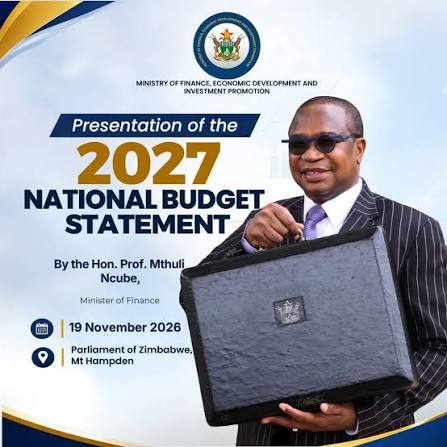
Finance Minister, Professor Mthuli Ncube, is expected to present the 2027 National Budget Statement, on 19 November, 2026, at the Parliament of Zimbabwe, in Mt Hampden, outlining Government’s spending priorities, proposed revenue measures and economic outlook for the coming year.
The Budget, being prepared under the theme, “Accelerating Economic Transformation and Building Resilience to Climate Shocks and Global Shocks,” is expected to prioritise economic stability, infrastructure development, agriculture, food security, job creation and social protection.
Finance Permanent Secretary, George Guvamatanga, indicated that the Budget would be guided by National Development Strategy 2 (NDS2), in line with Zimbabwe’s Vision 2030 objectives.
He said Government’s priorities included “economic stability, infrastructure and housing, agriculture and food security, job creation, youth entrepreneurship, social protection and development through devolution”.
Climate resilience is also expected to take centre stage, with Treasury highlighting investment in irrigation, drought-tolerant crops and disaster preparedness.
The Ministry has emphasised the importance of strengthening the country’s capacity to withstand climate-related challenges while protecting agricultural production and vulnerable households.
Irrigation development and the promotion of drought-tolerant crops are among the key interventions expected to strengthen resilience, particularly in the face of recurring climate shocks.
Budget preparations have included nationwide public consultations and a pre-Budget seminar in Bulawayo, where legislators and Government ministries discussed funding priorities, resource requirements and concerns raised by communities.
For farmers, the focus will be on measures to strengthen agricultural production and food security, while businesses will be keen to understand proposed tax measures and incentives to support investment and industrial growth.
Health, education, roads, electricity and local development are also expected to feature prominently in the fiscal plan.
The key test will be how effectively the proposed allocations translate into improved public services, employment opportunities and sustainable economic growth.
The actual expenditure allocations and revenue measures will become clear when Professor Ncube presents the Budget on Thursday.