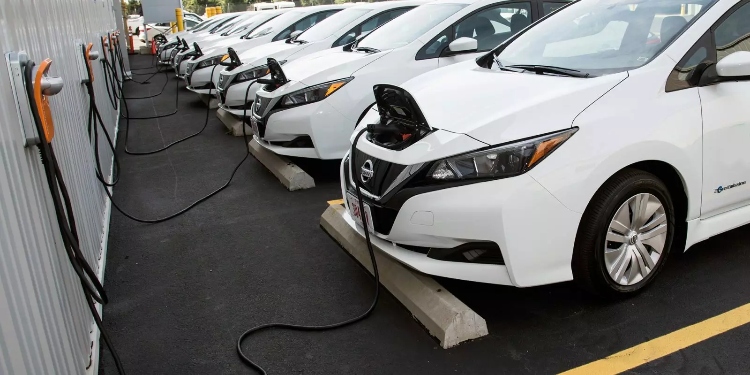
The Egyptian government has decided to accelerate the adoption of electric vehicles (EVs) to reduce dependence on petroleum imports and ease long-term pressures on its budget. In the 2024/2025 fiscal year, petroleum imports cost the country $21bn, so EVs are a practical measure to curb foreign currency outflows while modernising the local transport sector.
Several years ago, an ambitious local EV manufacturing plan was developed through partnerships with international producers, especially those in China. That strategy has now acquired more urgency in the wake of the US-Israeli war against Iran and its impact on global supply chains. Heavily dependent on petroleum imports from Gulf countries, Egypt suffered from Iran’s closure of the Strait of Hormuz, when oil imports dried up, raising the cost for both the state and consumers.
Even before the war, petroleum imports were putting serious pressure on the state budget, which was already strained. This makes EVs a potential economic lifesaver. The government’s decision means ditching thousands of internal combustion engine (ICE) vehicles used by workers in Egypt’s bloated public sector, replacing them with EVs.
Economist Rashad Abdo said reducing fuel consumption and related costs meant increasing dependence on non-fuel-consuming transportation. “The petroleum import bill has become a real concern for the Egyptian government, given its huge volume,” said Abdo, a professor of economics at Helwan University, speaking to Al Majalla.
Transport accounts for almost a third of Egypt’s annual energy consumption, even more than industry, which accounts for 28%. This shows the impact of ICEs, as does walking on the fume-filled streets of Cairo, where combustion engines also have an environmental cost.
The Egyptian capital is one of the world’s most polluted cities. Engines account for almost 33% of fine inhalable particulate matter (commonly known as PM2.5) levels in Greater Cairo, which includes Giza and Qaluibia. By the end of 2025, Egypt had more than 11 million licensed vehicles. Almost all were ICEs. Around one in four cars is in Cairo, a city of ten million.
In 2023, the government launched the Automotive Industry Development Programme, a national strategy for the localisation of automotive manufacturing through investment, with EVs at its heart. The goal is to transform Egypt into a leading vehicle manufacturing and export hub, capitalising on its geographic location, abundant human resources, and an improving investment climate.
The same programme aims to increase the scale of domestic production, using local components, to 100,000 EVs annually. Agreements with Chinese partners aim to transform Egypt’s car assembly factories into competitive industrial hubs that rely on 60% locally made components.