
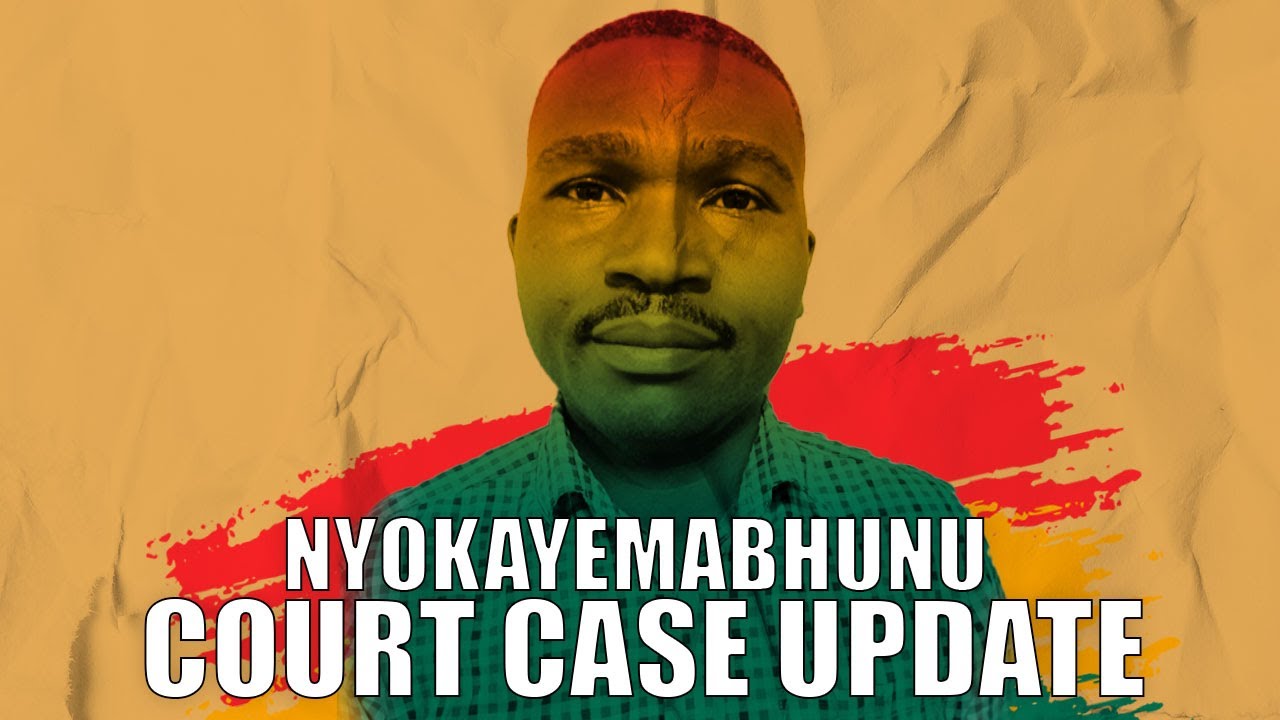
The Randburg Magistrate’s Court in South Africa has ruled that political activist, Wellington Masiwa, popularly known as Nyokayemabhunu, is liable to be extradited to Zimbabwe after rejecting his legal challenge against surrendering him to face a sentence arising from a fraud conviction.
In a judgment delivered on Monday, the court found that Zimbabwe had satisfied all the legal requirements for extradition under the Southern African Development Community (SADC) Protocol on Extradition and South Africa’s Extradition Act.
“The Respondent is liable to be surrendered to Zimbabwe for the crime set out in the formal extradition documentation,” the magistrate ruled.
The court further ordered that Masiwa remain in custody pending a final decision by South Africa’s Minister of Justice and Constitutional Development on whether he should be extradited to Zimbabwe.
“The Respondent is ordered to be committed to prison to await the decision of the Minister of Justice and Constitutional Development with regard to his surrender,” the judgment stated.
Masiwa has 15 days to appeal the ruling before South Africa’s High Court.
Zimbabwe is seeking Masiwa in connection with a fraud case in which he previously pleaded guilty before leaving the country. He was sentenced to 24 months’ imprisonment, wholly suspended on condition that he complied with several requirements, including paying US$3 660 in restitution to the complainant, Prince Kuvito.
Zimbabwean authorities contend that Masiwa failed to meet those conditions, prompting the request for his extradition to serve the sentence.
During the proceedings, Masiwa’s legal team argued that the extradition application did not satisfy the principle of dual criminality, which requires the alleged offence to constitute a crime in both requesting and requested states.
However, the magistrate dismissed the argument, ruling that fraud is recognised as a criminal offence in both Zimbabwe and South Africa.
“Accordingly, this court is satisfied that the provisions of the Protocol and the Extradition Act… have been successfully met,” the court said.
Masiwa also argued that returning to Zimbabwe would expose him to political persecution because of his activism.
He told the court that he fled Zimbabwe following the November 2017 military intervention, claiming he feared persecution because of his political activities. According to his testimony, he went into hiding before crossing into South Africa, where he later applied for asylum.
He further claimed that his life would be at risk if he returned to Zimbabwe, alleging that he had been declared ‘an enemy of the Zimbabwean state’, placed on a ‘hit list’, and feared he would be poisoned and killed upon his return.
Masiwa also testified that he did not return to Zimbabwe following the death of his first wife because he believed the attack that resulted in her death had been intended as a warning to him.
The magistrate, however, ruled that the extradition court was not empowered to determine whether Masiwa would face persecution or receive a fair trial in Zimbabwe, saying those considerations fall within the discretion of South Africa’s Minister of Justice and Constitutional Development.
“It is clear… that this court cannot make a finding on the Respondent’s evidence regarding his persecution in his home country or if he will have a fair trial,” the judgment stated.
The judgment marks a significant step in Zimbabwe’s bid to secure Masiwa’s return, although the extradition process is not yet complete. The final decision now lies with South Africa’s Minister of Justice and Constitutional Development, subject to any appeal Masiwa may lodge before the High Court within the prescribed 15-day period.