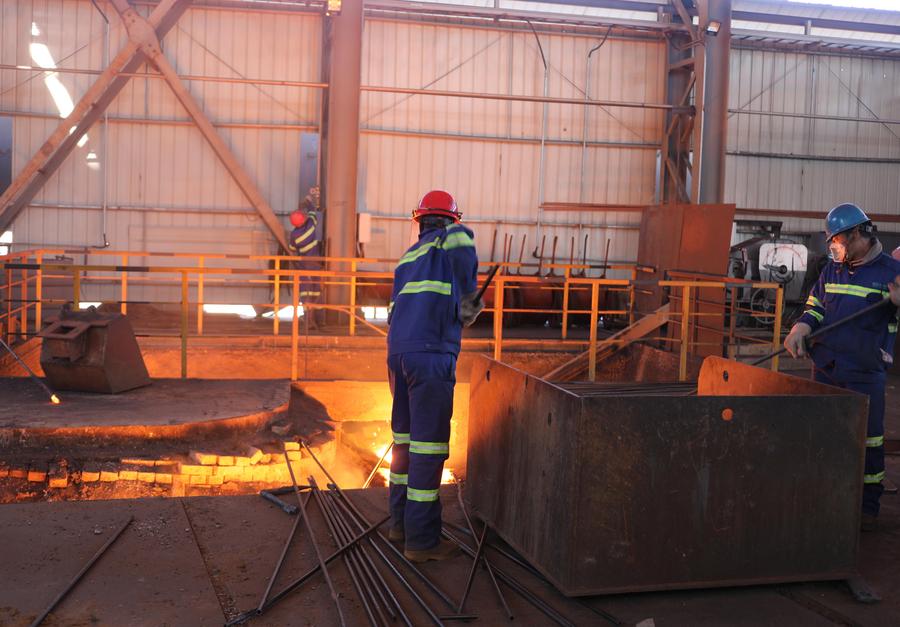
The US$1.5 billion Dinson Iron and Steel Company (DISCO) in Manhize is strengthening Zimbabwe’s import substitution drive by supplying locally produced steel to domestic industries, a development expected to reduce reliance on imports, save foreign currency and accelerate industrialisation.
As part of the Ministry of Information, Publicity and Broadcasting Services’ media tour of high-impact projects in Midlands Province, journalists on Wednesday toured the Dinson Iron and Steel Company, where they were briefed on the company’s operations and its growing contribution to Zimbabwe’s manufacturing sector and industrialisation agenda.
The Ministry of Information, Publicity and Broadcasting Services said the tour was aimed at highlighting transformative projects that are reshaping Zimbabwe’s economy through large-scale investments in key productive sectors.
“The media tour’s first stop was at Dinson Iron and Steel Company in Manhize. The US$1.5 billion integrated steel plant is a subsidiary of China’s Tsingshan Holding Group.
“The plant began pig iron production in July 2024 and has set an annual production target of up to 1.2 million tonnes, positioning it among the largest steel manufacturing facilities in the region,” the Ministry added.
According to the Ministry, the plant’s blast furnaces are operating at full capacity while its continuous casting section is fully operational, producing steel billets and slabs for industrial use.
“The blast furnaces are operating at full capacity, and continuous casting is fully operational, producing steel billets and slabs,” the Ministry said.
The Ministry said the company has adopted a market strategy that gives priority to domestic demand before exporting excess production, a move expected to reduce Zimbabwe’s dependence on imported steel products.
“Currently, Dinson’s market is 60 percent domestic and 40 percent foreign, dominated by SADC countries. The major focus for now is on the local market, with the surplus for export. This strategy promotes import substitution for steel products,” the Ministry said.
By supplying locally manufactured steel to domestic industries, the company is expected to strengthen value addition, reduce foreign currency expenditure on imports and support downstream manufacturing sectors that rely on steel inputs.
The export of surplus production to regional markets is also expected to boost Zimbabwe’s export earnings while consolidating the country’s position as an emerging steel producer within the Southern African Development Community (SADC).