
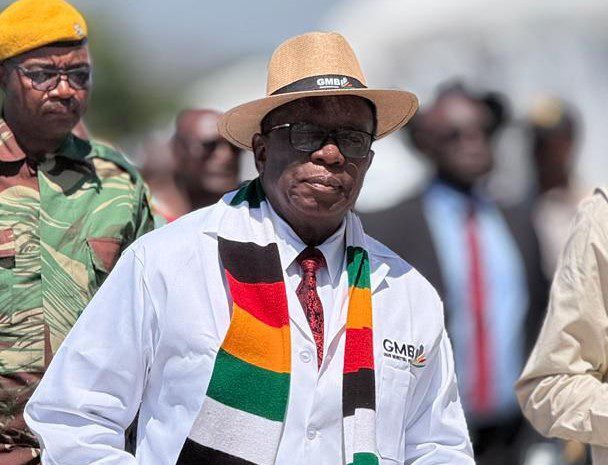
In a landmark move signalling Zimbabwe’s embrace of advanced agricultural technologies, President Emmerson Mnangagwa yesterday officially commissioned the state-of-the-art Artificial Intelligence-powered Grain Marketing Board (GMB) Silo Complex in Mutare. The facility stands as a major milestone in the country’s drive towards modern, efficient, and resilient food systems, reflecting the Second Republic’s commitment to ensuring stable, secure, and nutritious food supplies for all citizens.
Speaking during the commissioning, President Mnangagwa noted that this strategic trade and agricultural hub is yet another milestone towards broadening effective grain and commodity storage solutions.
“It is my singular honour and privilege to officiate at this ceremony, commissioning the state-of-the-art Artificial Intelligence-powered Grain Marketing Board Silo Complex, here in Mutare. It demonstrates that the Second Republic remains seized with guaranteeing stable, secure, safe and nutritious food supplies in our country,” said President Mnangagwa.
The Mutare GMB facility, with a total capacity of 56,000 metric tonnes, is more than an infrastructural investment, it is a symbol of innovation and resilience. Equipped with digital monitoring systems, automated grain handling technologies, and advanced quality control laboratories, the complex embodies the Fourth Industrial Revolution’s impact on agriculture.
“Such contemporary systems enhance grain storage efficiency, reduce post-harvest losses and ensure national food safety through improved risk monitoring and globally acclaimed management standards,” the President noted.
He further highlighted that features such as built-in dryers, dust extraction systems, and improved ventilation make these facilities ideal for long-term grain storage.
The Mutare Silo Complex is one of 14 new AI-driven silo sites being constructed nationwide to increase Zimbabwe’s grain storage capacity by 750,000 metric tonnes. Other sites are currently under development in Masvingo, Marondera, Lupane, Gokwe, and Bindura, among others.
“In line with the Devolution and Decentralisation Agenda, my Administration continues to bring development, goods and services closer to grassroots communities,” President Mnangagwa said. “Chirimai muzadze matura nzvimbo yekuchengeta zvirimwa zvenyu yavapo,” he added, urging farmers to make full use of the new storage infrastructure.
President Mnangagwa noted that despite challenges posed by illegal sanctions and climate change-induced droughts, Zimbabwe’s agricultural transformation continues to inspire confidence. The President revealed that the World Food Programme has expressed readiness to collaborate with Zimbabwe in transforming the nation into a regional hub for food production, storage, and logistics.
During the event, President Mnangagwa also launched the Agriculture, Food Systems and Rural Transformation Strategy 2 (2026–2030), building on the success of the first phase.
“The emphasis is now on consolidating the gains of our resilient agricultural sector. Agricultural production must be assured, while national food sovereignty and improved nutrition should be enhanced through the food systems and value chain approach,” he said.
The new strategy focuses on sustainable production, climate resilience, innovation, research, rural industrialisation, and trade development all geared toward increasing value creation and boosting household incomes.
“I look forward to collaboration from all stakeholders in the agriculture space, including farmers, the private sector, and development partners,” President Mnangagwa stated. “Together, let us continue working with unity of purpose to fully unlock the potential of our sector, riding on our God-given land and water resources.”
Concluding his address, the President congratulated the Ministry of Lands, Agriculture, Fisheries, Water and Rural Development, the GMB, and all stakeholders for their dedication. “With these remarks, it is now my singular honour and privilege to declare the Grain Marketing Board Smart Silos here in Mutare commissioned, and the Agriculture, Food Systems and Rural Transformation Strategy 2 officially launched.”