Some years ago, a borehole drilling company struck water in Simwenge Village under Chief Siansundu in Binga, sparking celebrations across the community. But the joy was short-lived. The water was hot and salty, likely the result of hitting a natural hot spring. Even after the Zimbabwe Red Cross Society (ZRCS) intervened in 2023 to rehabilitate the borehole, the problem persisted, leaving the community in ongoing water distress.
The old borehole served 93 households but frequently broke down due to the high temperature of the water.
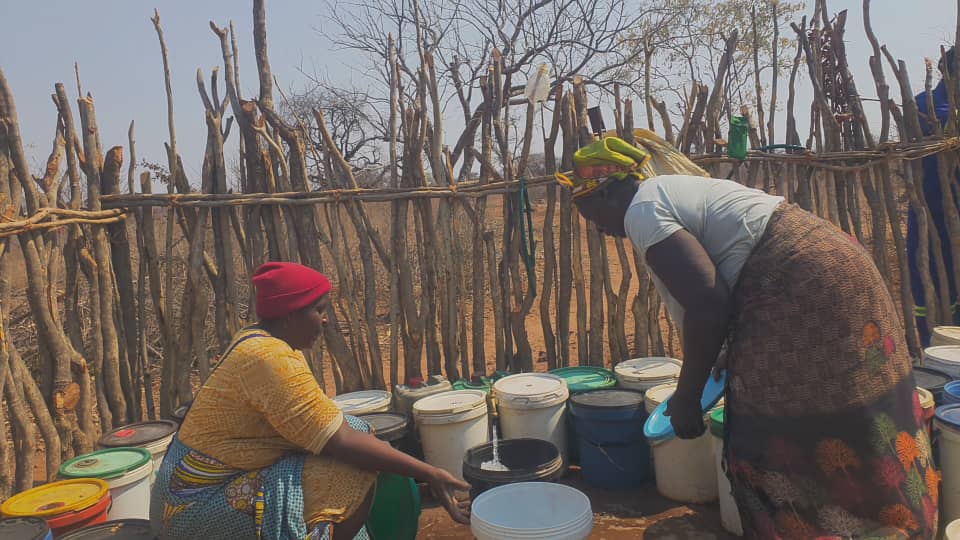
“The water was very salty and hot; you could not drink it or even touch it immediately after fetching it,” narrated Mrs. Pauline Mudenda from Simwenge. “We would wait about 20 minutes for the water to cool down before we could use it.”
For decades, villagers struggled with daily water challenges. Each failed borehole deepened their despair, forcing many to walk long distances to fetch water from rivers or neighbouring villages with drinkable water.
Binga has the highest proportion of households relying on surface water. Data from the 2025 Zimbabwe Livelihoods Assessment Committee (ZimLAC) shows that 29.8 percent of households in Binga drink surface water, followed by Mangwe at 26.7 percent.
For the Siansundu community, however, the tide is turning. The Zimbabwe Red Cross Society, in partnership with the Finnish Red Cross, has installed a tap system drawing water directly from the Mlibizi River. The water is channeled through the ZINWA purification plant before being distributed via a four-kilometre pipeline to Simwenge and surrounding villages. This is part of the Red Cross’s Climate Smart Resilience (CSR) project, implemented alongside other initiatives in Binga since 2022.
For the first time in decades, clean, safe water flows steadily into the community, a sight many had stopped believing they would ever see.
“We are now grateful to the Red Cross for this intervention. We now have four taps where we fetch water. The water is drinkable and safe, unlike previously, when we had to drink from the old borehole out of desperation,” added Mudenda.
The ZINWA water treatment plant in Binga, commissioned in 2020, was designed to improve the area’s water supply and accommodate mini pipelines like the one serving Simwenge. The old borehole, once bitter and hot, is now primarily used for domestic chores and livestock, earning it the new name Simwenge 2.
Tracy Munzamba, a Simwenge villager benefiting from the water project, praised the Red Cross for reviving the old borehole for livestock and other uses.
“We are grateful to the Red Cross for ensuring that even our livestock is not left out of the water program. Even though this borehole water is not suitable for human consumption due to its saltiness and heat, our livestock is catered for. We also use it for washing and other domestic chores,” said Munzamba.
Mrs Sphiwe Sibanda, district field Officer for the Climate Smart Resiliance Project, explained the process:
“The community requested an extension of the pipeline from the Mlibizi line, which supplies the clinic. We responded and assisted them. As a community, they sourced resources to extend the pipeline by 1.5 kilometres. We supported them with 2.5 kilometres, making a total of four kilometres. They now have potable water from the treated Mlibizi River.”
Jacob Mpande, Chairperson for the Simwenge pipeline, said they were waiting for ZINWA’s approval to install four taps.
“As a community, we each contributed US$5 to set up this pipeline and connect to the ZINWA plant. After connecting 1.5 kilometres, we requested assistance from the Red Cross. They provided 420 pipes and four taps. Now we are just waiting for ZINWA’s green light so we can install the taps and bring water closer to those who live far from the existing source,” said Mpande.
Currently, 93 households access water from the Simwenge pipeline. Adding more taps will ease congestion and make water more accessible.
The Climate Smart Resilience project, which began in October 2022, is set to conclude on December 31, 2025. Nelson Nkuli, Livelihoods Officer under the CSR project, highlighted its impact:
“In terms of water, we have rehabilitated about 12 water points in Saba and Siansundu. We installed completely new equipment, replacing old systems to ensure the water points last longer,” said Nkuli.
After years of hardship, the people of Simwenge can now enjoy a reliable water supply, with safe drinking water flowing steadily into their homes. What was once a daily struggle has been transformed into a story of resilience, innovation, and hope, showing that even the most entrenched challenges can be overcome with collective effort and visionary intervention.
Source: Health Times