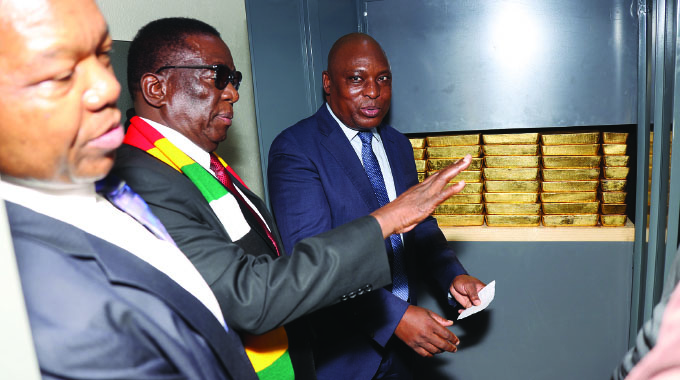
Zimbabwe’s drive to stabilise its domestic currency has received a major boost, with the Reserve Bank of Zimbabwe (RBZ) announcing that reserves backing the Zimbabwe Gold (ZiG) currency have surged to US$1 billion. This marks the first time since the currency’s introduction that reserves have reached such levels, providing 1.2 months of import cover and reinforcing confidence in the local currency.
The milestone comes at a time when the country is also benefiting from exceptionally strong foreign currency inflows. According to the RBZ’s latest monetary policy statement, released after Monday’s Monetary Policy Committee meeting, Zimbabwe’s export receipts hit US$13 billion in the first 10 months of 2025 the highest on record. This represents a 21 percent increase compared to the same period in 2024.
The central bank noted that these gains reflect a strengthening economy and a more predictable foreign exchange environment. The rising reserves have supported the smooth operation of the Willing-Buyer Willing-Seller (WBWS) foreign exchange system, ensuring that all bona fide import and foreign payment requirements are fully met.
“In the 10 months to October 2025, total foreign currency inflows amounted to more than US$13 billion,” the statement reads. “Reflective of the sustained inflows, reserves backing the ZiG reached current levels of about US$1 billion, equivalent to more than 1.2 months of import cover.”
The MPC described these developments as significant progress towards fulfilling the Conditions Precedent (CPs) required for Zimbabwe’s transition to a monocurrency system by 2030, as outlined in both the 2026 National Budget and the National Development Strategy 2 (NDS2).
The committee also applauded the government’s move to reduce the Intermediated Money Transfer Tax (IMTT) on ZiG-to-ZiG transactions from 2 percent to 1.5 percent. This reduction, announced in the 2026 National Budget, is expected to promote greater use of the local currency and deepen financial inclusion.
“This measure is critical to complement monetary policy efforts aimed at promoting broader domestic currency usage and supporting the eventual transition to a monocurrency,” the RBZ said.
Furthermore, the MPC welcomed the launch of the National Development Strategy 2 (2026–2030), noting that macroeconomic stability and greater financial sector depth will be essential to achieving Vision 2030, a roadmap toward an empowered, prosperous upper-middle-income society.
Overall, the combination of swelling reserves, robust export performance and supportive policy reforms signals that Zimbabwe is gaining momentum on its path toward long-term currency stability and economic transformation