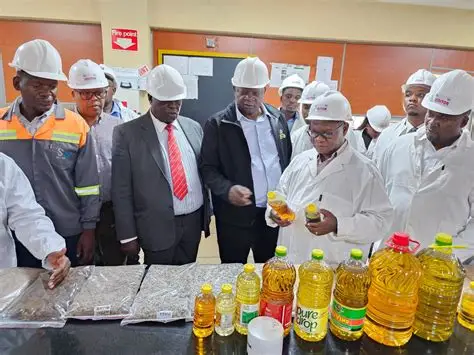
Zimbabwe is targeting cooking oil self-sufficiency by 2027, through expanded local production of oilseeds, in a strategy expected to significantly cut the country’s crude cooking oil import bill, currently estimated at more than US$100 million annually.
The plan focuses on scaling up the production of key oilseed crops including soya beans, sunflower and cotton, as Government intensifies efforts to replace imports with locally produced raw materials.
Speaking during a farm tour in Mashonaland Central Province, yesterday, Minister of Lands, Agriculture, Fisheries, Water and Rural Development, Dr Anxious Masuka, said Government has adopted a phased and comprehensive agricultural production system designed to ensure national self-sufficiency.
“We started with satisfying the stomach and looked at which crops to produce maize, millet, sorghum; from there we looked at feed security for poultry and piggery, then we looked at oilseed security. The plants that give us that are sunflower, cotton and soybeans. If we get into the next season with these, we can produce enough oil and stop imports,” Dr Masuka said.
Farmers across the country are already responding to the policy push, with notable progress recorded in Mashonaland Central Province.
At Kushinga Farm, in Mazowe, 180 hectares of soya beans are performing strongly this season, reflecting growing confidence in oilseed production.
Farm Manager, Wallace Nhevera said the crop benefited from timely planting and favourable rains.
“We produced 180 hectares of soya beans this year, and it was planted on November 23. We realised that if we farm soya beans, we will help the country to produce cooking oil and other products. We expect four and a half tonnes,” he said.
Agronomist, Blessing Hatidane, said the farm’s progress mirrors a broader national shift towards industrial crop production and seed security.
“We are working well with our farmer who produced 180 hectares of soya beans, it is not a joke if you are in commercial farming. Soya beans give us food and stock feed, so it is an important crop,” Hatidane said.
Zimbabwe requires about 180 million litres of cooking oil annually and continues to rely heavily on imported crude soya bean and sunflower oil for domestic processing.
To stimulate local production, Government last year gazetted Statutory Instrument 87 of 2025, which compels cooking oil producers to source at least 40 percent of their oilseeds and related products locally by April this year.
The policy is expected to spur investment in oilseed farming and strengthen value chains, particularly in high-performing districts such as Mazowe, as Zimbabwe advances its import-substitution and agro-industrial development agenda.