
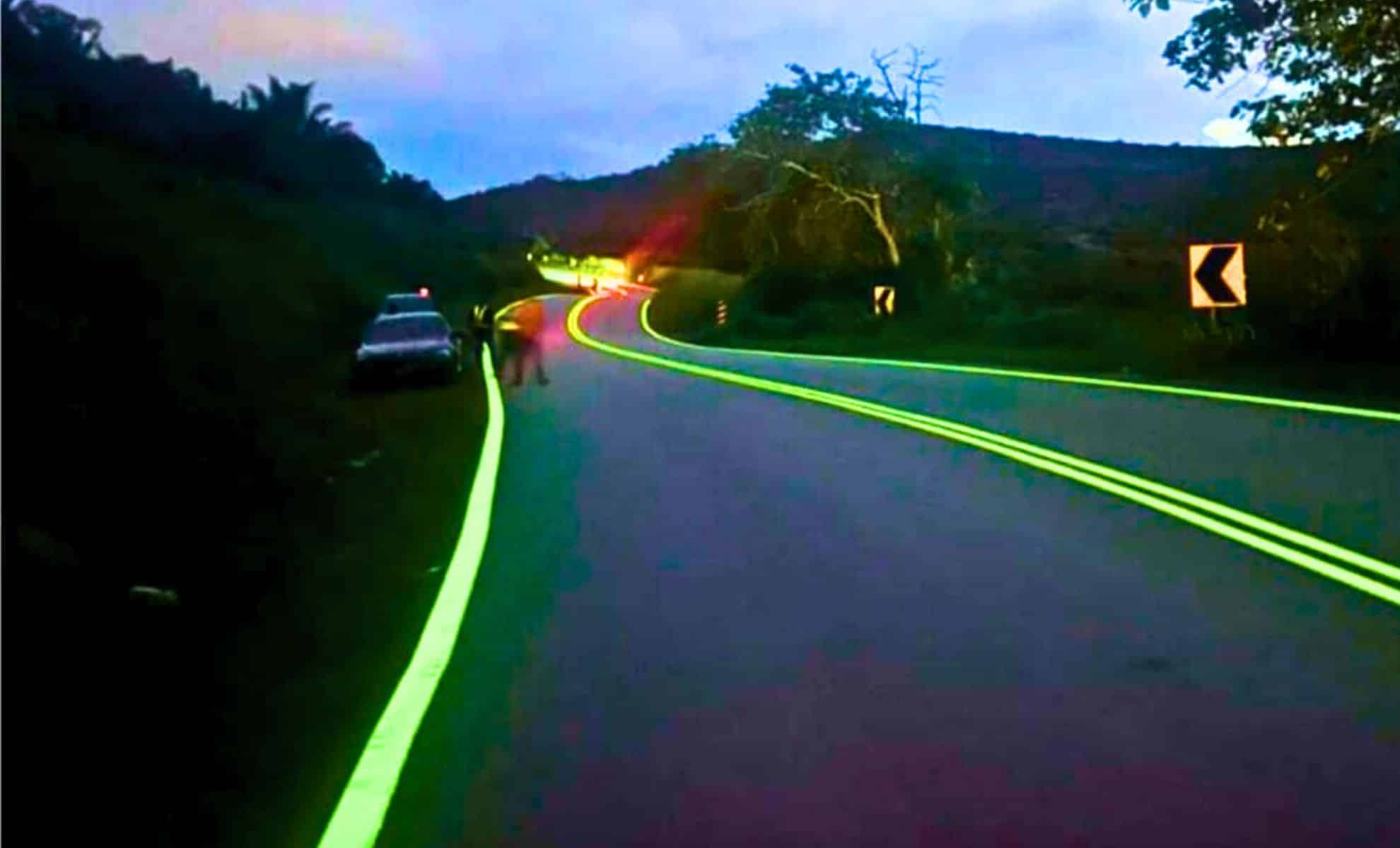
On a two-lane road near Semenyih, in Malaysia’s Selangor state, something unexpected, greeted drivers after dark in late 2023. The lane markings glowed. Not from streetlights or reflective paint bouncing back headlamp beams, but from the road surface itself, drawing its light from sunlight stored during the day and releasing it slowly through the night.
The 245-metre stretch, installed by the Hulu Langat district branch of Malaysia’s Public Works Department (JKR) between Jalan Sungai Lalang and Jalan Sungai Tekali, was the country’s first deployment of photoluminescent road markings. The technology, long discussed in road safety circles as an alternative to road studs and conventional lane paint, appeared to address a genuine hazard: thousands of kilometres of rural Malaysian road with little or no lighting infrastructure, and a national road death toll exceeding 6,000 lives each year.
Within weeks, expansion plans multiplied. Selangor’s state government announced it was considering 15 further locations. Johor identified 31 roads for its own pilot programme. The public reaction was broadly enthusiastic, particularly from drivers who noted the markings remained visible during heavy rain and fog, conditions that render standard retroreflective; paint nearly useless.
Twelve months later, Deputy Works Minister Ahmad Maslan stood in the Dewan Rakyat and announced the government would not proceed. The glowing lanes, it turned out, carried a price that no road safety argument could justify at scale.
Works Minister Alexander Nanta Linggi had flagged the cost disparity before the Parliamentary disclosure. The photo-luminescent paint used in the trials costs RM749 per square metre, against RM40 per square metre for conventional road marking paint, making it nearly 20 times more expensive than standard paint, based on figures published by Paul Tan’s Automotive News.
In November 2024, Ahmad Maslan told Parliament that the pilots in Selangor and Johor had not performed as expected. “The cost is too high, so we are probably not going to continue with the glow-in-the-dark lanes,” he said in the Dewan Rakyat. A second statement confirmed that field reviews had fallen short of the ministry’s benchmarks: “We ran tests, but it did not satisfy the experts from the ministry.”
The combined weight of those two disclosures closed the programme. Plans for Selangor’s 15-location expansion and Johor’s 31-road pilot were shelved. The Semenyih installation, originally presented as the first step in a broader national road safety upgrade, remained a single data point.
How the Technology Works, and Where It Fails in Tropical Conditions
Photoluminescent road markings use strontium aluminate, a phosphorescent compound that absorbs solar radiation during daylight hours and re-emits it as visible light after dark. The formulation requires no electrical input and is independent of vehicle headlights, which is its principal advantage over standard retroreflective systems. Retroreflective paint relies on embedded glass beads bouncing light back toward the driver; those beads lose effectiveness when submerged in rainwater, which is why conventional markings become difficult to read during heavy downpours.
The Semenyih deployment was designed to glow for up to ten hours after sunset. Drivers and road safety observers noted the markings performed particularly well in wet conditions, the scenario in which the technology’s optical independence from retroreflection matters most. Malaysia’s annual rainfall, concentrated in monsoon periods and spread across the country, makes that operational advantage relevant on a large share of its road network.
The durability picture in tropical environments is considerably less favourable. Researchers at Malaysia’s Institute of Road Safety Research (MIROS) raised concerns about the coating’s longevity under sustained heat, high humidity, and ultraviolet intensity. A 2021 study in the International Journal of Pavement Research and Technology reported that photoluminescent coatings in tropical conditions degrade faster than in temperate climates, with field performance declining to a point where reapplication is needed within approximately 18 months. That reapplication requirement compounds the already severe cost differential over any multi-year deployment horizon.
Prior Deployments in the Netherlands and Japan Offered a Different Model
Photoluminescent road infrastructure had been trialled elsewhere before Malaysia’s deployment. Experimental installations in the Netherlands and Japan from the early 2010s onward tested the technology on cycle paths and short highway sections. Those deployments were principally design-led and limited in scope, intended to evaluate aesthetic and wayfinding applications rather than replace conventional lighting on high-traffic routes.
The ambition of the Malaysian trial was different in kind. JKR’s Semenyih installation was explicitly framed as an alternative to road studs and streetlight infrastructure in areas with unreliable or absent power supply. That functional scope places far greater demands on durability and brightness consistency than a cycle path application. It also requires cost performance that no currently available commercial product has reached.
Researchers at Delft University of Technology in the Netherlands and at Japan’s National Institute for Land and Infrastructure Management continue to develop reformulations of strontium aluminate composites and improved protective overcoat chemistries aimed at reducing cost and extending tropical service life. Neither institution had published deployment-ready specifications as of early 2026.
The Maintenance Gap That the Trial Brought Into View
The public response to the Semenyih trial shifted tone as the programme expanded and then contracted. Early enthusiasm gave way to a louder complaint: that the country’s existing road markings were already faded, incomplete, or absent on many rural routes, and that the basic maintenance of conventional infrastructure had been neglected in favour of a high-cost experiment.
That criticism reflects a wider issue in rural road safety in Malaysia. Standard thermoplastic road markings on unlit rural routes degrade under traffic and weather, and repainting schedules have not kept pace with deterioration rates in all districts. The visibility problem that photoluminescent paint was meant to solve persists on roads where the conventional solution has simply not been applied consistently.
For the photoluminescent technology itself, the threshold conditions for viable deployment remain clearly defined: a unit cost low enough to compete meaningfully with conventional paint on a five-year total-cost basis, and documented field durability of at least five years in high-humidity tropical conditions without reapplication. Malaysia’s trial produced useful data on both counts. It confirmed that neither condition is currently met by any commercially available product