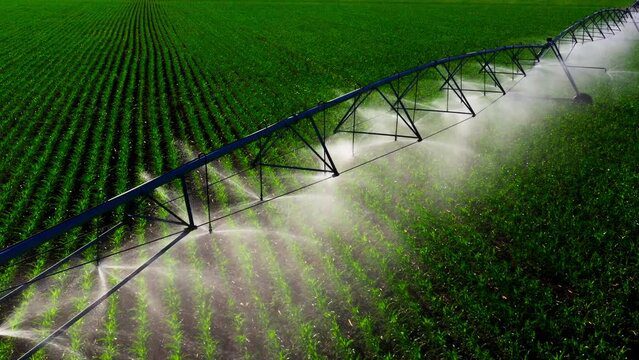
At least 1 796 hectares of irrigable land is set to be brought back into production following the rehabilitation of 24 irrigation schemes financed through the Grain Levy, as Government intensifies preparations for a projected 2026/2027 El Niño season.
The programme, funded through the Agricultural Marketing Fund (AMF) established under Statutory Instrument 87 of 2025, is part of a broader Government strategy to strengthen food security, increase agricultural productivity and reduce reliance on grain imports.
The Grain Levy, which is collected by the Agricultural Marketing Authority (AMA) on imported grain, was introduced to mobilise sustainable funding for strategic agricultural investments, particularly irrigation development and climate resilience initiatives.
The irrigation expansion comes as weather experts forecast a 90% probability of below-normal rainfall across Southern Africa during the forthcoming agricultural season. In response, Government has intensified climate adaptation measures that include irrigation development, mechanisation, water harvesting, climate-smart agriculture and the promotion of drought-tolerant crop varieties.
Last week, President Emmerson Mnangagwa urged farmers to plant early maturing and drought-resistant crops, assuring the nation that comprehensive interventions were already underway to cushion the agricultural sector against the anticipated dry spell.
Government is targeting 1,8 million hectares of maize and more than 500 000 hectares of traditional grains during the 2026/2027 summer cropping season, with irrigation expected to play a central role in sustaining production.
More than US$3,2 million and ZiG29 million have already been disbursed through the Agricultural Marketing Fund towards irrigation rehabilitation projects, many of which are nearing completion.
AMA Marketing and Public Relations Manager Tina Nleya said the authority was already witnessing positive results from the Grain Levy-funded programme.
“So far, we have rehabilitated 24 irrigation schemes covering 1 796 hectares of land. Nyaitenga Irrigation Scheme is now 100% complete, while most of the remaining schemes are between 60% and 100% complete,” she said.
She added that additional funding would be released once the current phase is completed.
“The Grain Levy has provided a sustainable financing mechanism that is not only rehabilitating irrigation infrastructure but also helping us aggregate agricultural production and secure reliable markets for farmers.”
According to AMA, completed irrigation schemes include Nyaitenga in Mashonaland East, Chimhanda in Mashonaland Central, Nyamangara in Mashonaland West and Hlauke in Matabeleland North, while several other projects are at advanced stages of implementation.
Permanent Secretary in the Ministry of Agriculture, Mechanisation and Water Resources Development, Professor Obert Jiri, recently said Zimbabwe’s climate resilience strategy is anchored on strengthening the Strategic Grain Reserve, expanding irrigation infrastructure, promoting Pfumvudza/Intwasa, increasing traditional grain production, encouraging climate-smart seed varieties and strengthening early warning systems.
Among the flagship projects is the US$120 000 Nyaitenga Irrigation Scheme in Murehwa, where 20 hectares have been restored to full production, benefiting more than 50 farming families after part of the scheme had remained non-functional for nearly five years.
Mashonaland East Provincial Irrigation Development Director, Engineer Catherine Mureri-Jaji, said the rehabilitation had transformed agricultural production within a short period.
“For almost five years, our drip section was completely down, but after the intervention through AMA funding, it took only one month to rehabilitate the scheme. Today, the entire irrigation system is fully functional.
“The project included repairing the main pipeline, replacing damaged filters and drip lines, installing a new pump and expanding the scheme by three hectares to accommodate youth farmers, she said.
Ward 25 Councillor, Chenjerai Kandemiri, said the rehabilitation had revitalised the local economy.
“People are back in the fields, household incomes are improving and the community has renewed hope. The project has created productive opportunities, particularly for young people who had become idle,” said Kandemiri.
With climate uncertainty expected to persist, the expansion of irrigation infrastructure is set to remain one of Government’s key interventions in safeguarding national food security, enhancing rural livelihoods and building a resilient agricultural sector.