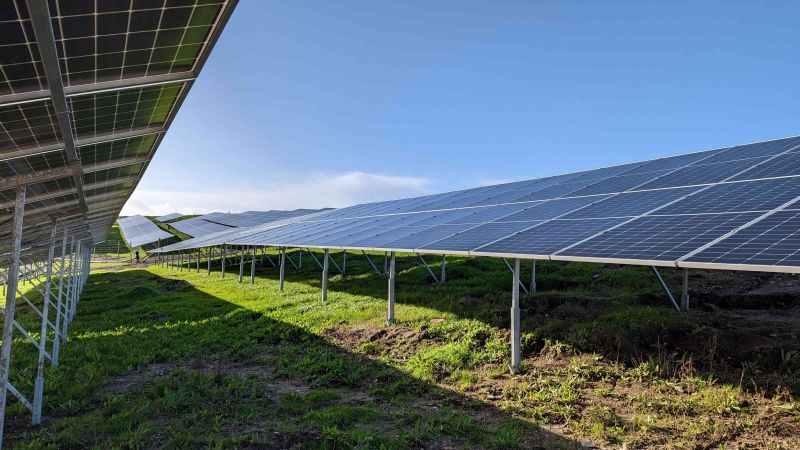
A US$100 million solar power project in Zvishavane is nearing completion, with the development expected to inject up to 100 megawatts into Zimbabwe’s electricity generation capacity and produce about 200 million kilowatt-hours of power annually.
The China-Zim Green Energy Solar Project, located at Mapanzure Solar Park, is being implemented through a public-private partnership as the country intensifies efforts to expand its energy generation capacity and improve electricity security.
Midlands Minister of State for Provincial Affairs and Devolution Owen Ncube toured the project yesterday as construction of Phase One entered its final stages.
The first phase, covering approximately 150 hectares, is expected to generate 60 megawatts peak, while a further 40 megawatts peak will be developed under Phase Two.
China-Zim Project Manager He Tian Jie said construction of the first phase was almost complete, paving the way for the second stage of the development.
“We are almost completing Phase One of this project, with an expected output of 60 megawatts peak. Then we move on to the second phase, where we expect 40 megawatts peak to be completed next year,” he said.
Once fully operational, the project will have a planned total installed capacity of 100 megawatt-peak on the Direct Current side and 85 megawatt-peak on the Alternating Current side.
Ncube said the development would make a significant contribution to Zimbabwe’s electricity requirements while supporting economic activity in the Midlands Province and beyond.
“I am reliably informed that the two-phased project, covering a total area of approximately 150 hectares, has a planned total installed capacity of 100 megawatt-peak on the Direct Current side and 85 megawatt-peak on the Alternating Current side.
“Upon full completion and operation, the project will achieve an annual power generation of 200 million kilowatt-hours,” he said.
The project has also received support from the local community, with Chief Mapanzure describing the investment as an important development that would contribute towards the objectives of the National Development Strategy 2 (NDS2).
“With this magnitude of development, the realisation of National Development Strategy 2 (NDS2) is quite certain. This is a clear testimony of developmental projects that contribute to the growth of our economy in many spheres,” he said.
The Mapanzure project comes as Zimbabwe continues to pursue new investments in the energy sector while rehabilitating and expanding existing generation infrastructure.
Ncube said partnerships with Independent Power Producers were critical in complementing established generation facilities such as Hwange Thermal Power Station and Kariba Hydropower Station.
He said the project reflected the Government’s broader drive to secure adequate electricity supplies and create an enabling environment for investment and economic growth.
The expansion of Hwange Units 7 and 8, alongside planned developments such as the Kariba Floating Solar Plant, forms part of Zimbabwe’s wider strategy to strengthen energy security.
The growing investment in renewable energy is also expected to support industrialisation, job creation and increased economic activity as Zimbabwe pursues its vision of attaining an upper-middle-income society by 2030.