
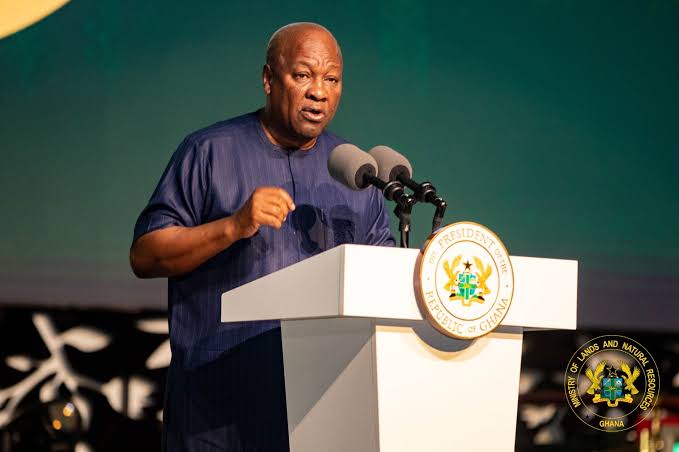
Ghanaian President John Dramani Mahama has announced a phased ban on the export of unprocessed minerals by 2030.
He said bauxite, manganese, iron, lithium and other resources must drive domestic industrial development rather than supply foreign factories.
Addressing the 2026 Mining in Motion Conference in Accra yesterday, President Mahama said legislation alone would not build an industry.
Investors, he said, must commit to local processing, while the government provided the infrastructure, skills and financing needed to make Ghana a competitive hub for refined minerals and value-added products.
“By 2030, raw mineral ores should no longer leave our shores,” he said. “Our alumina, manganese, iron, lithium and other minerals must support processing and industrial development here at home,” President Mahama declared.
The event was organised by the Ashanti Green Initiative, led by Nana Kwaku Duah, a son of the Asantehene, Otumfuo Osei Tutu II.
The Ministry of Lands and Natural Resources served as principal convening partner, with support from the World Bank, the World Gold Council and the African Union (AU).
Among the participants were Liberia’s Vice-President, Jeremiah Kpan Koung; a former UK Deputy Prime Minister, Dominic Raab; the Lands and Natural Resources Minister, Emmanuel Armah-Kofi Buah; the Minister of Environment, Science and Technology, Dr Zanetor Agyeman-Rawlings; the Secretary-General of the Organisation for Economic Cooperation and Development (OECD), Mathias Cormann; AU officials, and ministers from Guinea, Tanzania, Nigeria, Sierra Leone, Malawi and Liberia.
Export ban
President Mahama said the prohibition would be phased in with legal measures, mineral-specific requirements and transparent implementation timetables.
Ghana has already banned the export of scrap iron and non-ferrous metals.
The President lamented that for generations, the country had exported manganese and bauxite, while importing finished products made from its own ores, denying the country skilled jobs and technological learning.
He cited the Ghana Integrated Aluminium Development Corporation (GIADEC) and the Ghana Integrated Iron & Steel Development Corporation (GIISDEC) as vehicles for linking bauxite to aluminium refining and iron ore to steel production.
The Ghana Gold Board and gold refining policy, the President added, were meant to retain more value through assaying and refining.
The President said investors must understand the processing obligations attached to access to Ghana’s resources.
The government, he said, must ensure predictability, clear institutional responsibilities, prompt approvals, reliable energy, adequate water, secure raw materials and transport links to markets.
He announced a local content policy to move mining companies from owner mining to contract mining by indigenous companies, while reassuring workers in operating gold mines that their pay and conditions would not be affected.
President Mahama reported that the Ghana Gold Board, established in April 2025, generated $10.8 billion from regulated small-scale gold exports, nearly double the $4.66 billion recorded in 2024.
Exports from the artisanal and small-scale sector, he said, also rose to 104 tonnes between April and December 2025, compared with 64 tonnes in 2024.
President Mahama called for a unified African voice on minerals, warning that poor negotiations and large concessions to foreign interests left African nations with only a fraction of the wealth extracted from their soil.
For his part, Mr Buah said the world needed Africa’s resources, but Africa was ready to welcome the world only through partnerships and mutual benefit.
The ministry, he said, would continue supporting the private sector to harness resources for jobs and economic development.
Representing the Asantehene, the Paramount Chief of Essumegya, Odeneho Okyere Kusi Ntrama, said the mining sector required substantial resources and transparency “every inch of the way” to avoid partisan controversy and operational risk.
He stressed the need to be intentional, adding that the new journey towards triumph required transparency “every inch of the way”.
Odeneho Ntrama said the presence of high-powered delegates from the global community meant that policies on mining were in the spotlight worldwide.