
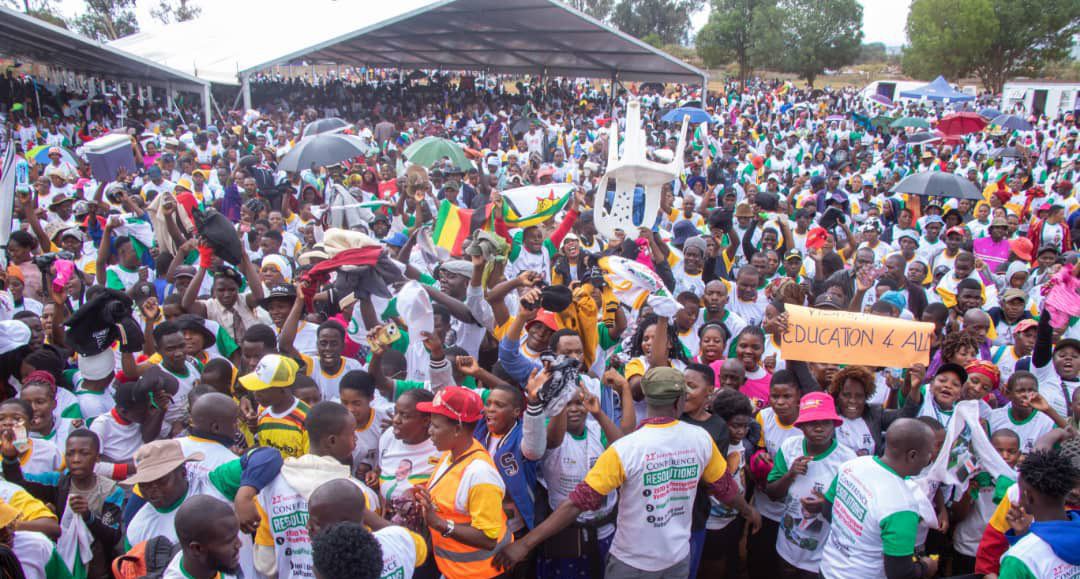
Something is shifting in Zimbabwe’s political landscape, and it is no longer subtle. For years, the urban spaces, especially Harare, were considered impenetrable opposition terrain, a place where ZANU PF structures struggled to gain visible traction. Yet today, thousands are attending ZANU PF District Coordinating Committee meetings across the capital, filling halls, community spaces, and open grounds with renewed energy. The change is not manufactured. It is not forced. It is a reflection of a political tide that is turning in real time, driven by delivery, stability, and the gradual disintegration of the opposition’s credibility.
The centre of this new shift is President Emmerson Mnangagwa, whose administration has delivered tangible improvements that citizens can feel in their daily lives. Zimbabwe is no longer in the chaotic spiral of wild inflation spikes that once made household budgeting an impossible task. Prices of basic commodities have remained stable for months, restoring a sense of predictability that ordinary families had long prayed for. Electricity supply, once the most frustrating part of national life, has improved significantly. Entire suburbs that previously endured punishing load shedding now enjoy consistent power, enabling businesses to operate with confidence and households to live with dignity.
These changes are not abstract policy points. They have influenced how people perceive national leadership. Citizens of all ages are reassessing the political narratives they once believed. In Harare, young professionals, informal traders, business people, students, and even long time opposition supporters are walking into ZANU PF meetings, saying openly that they are joining the party because it is delivering what matters. A new middle class has emerged, one that is ambitious, financially empowered, and increasingly patriotic. This group is not merely joining the ruling party. It is mobilising. It is organising. It is bringing its networks, its influence, and its confidence into the political arena, and ZANU PF is the natural home it is choosing.
Part of this momentum comes from the vibrant ecosystem of affiliate organisations that have taken the party’s message to every corner of society. These groups have become powerful bridges between the ruling party and the youth. They speak the language of the street, the language of the classroom, the language of enterprise, and the language of aspiration. Through mentorship programmes, empowerment initiatives, community activities, and leadership development drives, these affiliates have attracted not only young members, but also those who had been sitting on the fence. Even some former opposition stalwarts have found renewed purpose in ZANU PF structures, openly stating that they want to be part of a political organisation that prioritises national interests.
While ZANU PF has been strengthening itself, the opposition has been falling apart, exposing a hollow core that many supporters are now embarrassed to defend. What once looked like a promising alternative has turned into a circus of empty rhetoric, exaggerated activism, and personal enrichment schemes masquerading as politics. Zimbabweans have watched opposition leaders preach change while living extravagant lives funded by donations, foreign backers, and the emotional loyalty of desperate supporters. They have sold snake oil masked as political strategy, shouting slogans instead of offering plans, and promising a future they have no intention of building.
Their failures are most visible in councils they have controlled for years. Harare, once a proud African capital, has been dragged into filth and disorder by opposition run municipalities that prioritised petty fights, tenders for friends, and personal grandstanding over public service. Roads have crumbled. Water supply has become unreliable. Garbage has piled up on street corners like monuments to incompetence. Clinics and community infrastructure have suffered neglect while corruption reports multiply. Residents have become accustomed to excuses instead of solutions, scandals instead of accountability, and chaos instead of governance.
It is no surprise that urban dwellers have begun to ask the most important question: if the opposition cannot run a city council, how can it run a country? The answer has become clear. It cannot. The opposition’s brand has collapsed under the weight of its own dishonesty, infighting, and childish politics. Zimbabweans, even those who once cheered for it, are walking away in disappointment.
ZANU PF, on the other hand, has shown resilience that few political organisations on the continent can match. It has reinvented itself, rejuvenated its structures, and aligned its agenda with national development. The party has demonstrated that stability, economic recovery, and national unity are not slogans. They are achievable. They are measurable. And they are already underway.
This is why Zimbabweans across generations are returning to the ruling party. They see a political home that places the nation first. They see leadership that delivers, leadership that listens, and leadership that is building foundations for long term prosperity. ZANU PF has become indomitable not because of history alone, but because of performance, organisation, and a clear national vision.
The political tide has turned. The people have seen enough to make up their minds. Zimbabwe is choosing progress, stability, and national interest. Zimbabwe is choosing ZANU PF.


Chamisa killed the opposition
President Mnangagwa is working hard. Hats off to the man
The For ED affiliates are a masterstroke. They are helping to mobilize
Opposition councils have exposed opposition incompetence. Better to return to ZANU PF
Chamisa’s incompetence and Mnangagwa’s competence are the reason why Hararians flock to ZANU PF rallies