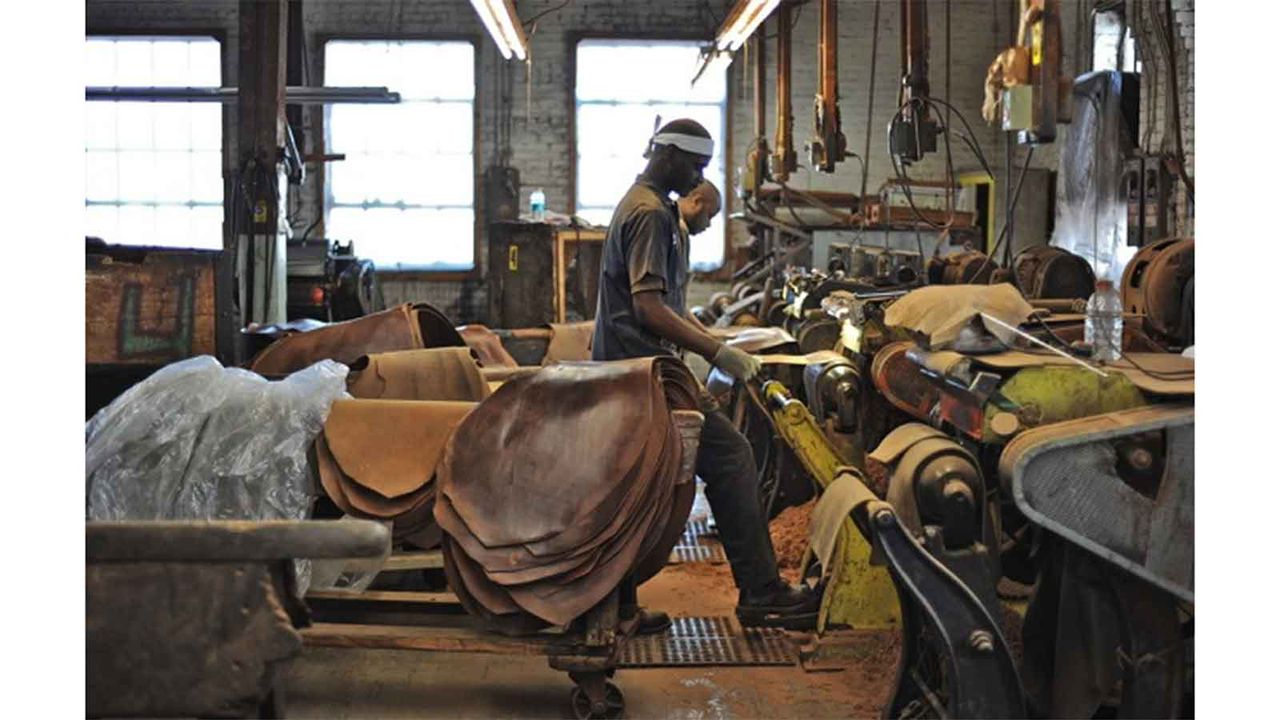
The establishment of a shoe soles, lasts and accessories manufacturing factory in Harare is set to transform Zimbabwe’s leather industry, which has long depended on imported components. Soles, lasts and other accessories are essential inputs for quality footwear production, and the new facility promises to significantly cut the volume of low-quality imports flooding the local market.
According to ZimTrade, Zimbabwe imports about 12.8 million pairs of shoes annually, out of an estimated national consumption of 14.3 million pairs across leather, canvas, synthetic and plastic categories. The launch of local manufacturing is therefore expected to strengthen domestic value chains and reduce reliance on foreign suppliers.
Lituo Shoe Outsoles and Accessories Manufacturing (Private) Limited, the company behind the project, has already installed several machines at its Harare plant and is currently adding more equipment to fully utilise its factory space.
Communications liaison, Kudzanai Dube, said additional machinery was in transit, with containers expected to arrive this weekend.
She confirmed that operations are scheduled to begin at the end of this month, with production capacity projected to reach up to 80 000 pairs of soles per month once the factory is fully operational. The Zimbabwe Investment and Development Agency (ZIDA) approved the investment at approximately US$1.2 million. This includes US$658 507 spent on imported capital equipment, US$500 000 for factory setup and infrastructure, and a US$50 000 foreign currency equity injection.
Dube said the company’s major shareholder, Zhang Datong, is committed to ensuring the factory meets international manufacturing and quality standards. Distribution will focus on supplying local manufacturers, leather processors, SMEs and industrial clusters across the country, reducing dependency on imported inputs and strengthening domestic supply chains.
The company is working closely with the Zimbabwe Leather Development Council (ZLDC) to deepen value chain linkages and plans to expand into regional markets once local demand is satisfied,” Dube noted that the investment is a significant milestone for the Zimbabwe Leather Sector Strategy (2021–2030), which aims to revive one of the country’s traditional industries.
One of the key challenges identified in the strategy is the limited local production of critical footwear components such as soles, lasts, accessories and modern machinery, forcing manufacturers to rely heavily on imports, increasing costs and slowing competitiveness. By producing these inputs locally, the new factory will promote import substitution, reduce lead times and strengthen both backward and forward linkages within the leather value chain.
The factory will also support skills development and technology transfer by employing local professionals and engaging experienced specialists to train and upskill the workforce. This aligns with national priorities of value addition and beneficiation, ensuring more leather is processed and transformed locally instead of being exported in semi-processed form.
Beyond industrial growth, experts note that quality footwear is vital for health, comfort and mobility. Poorly made shoes can contribute to conditions such as plantar fasciitis, bunions and Achilles tendonitis, while well-designed footwear helps absorb shock and prevent strain on joints.
ZLDC secretary, Jacob Nyathi highlighted the wide scope of the leather value chain from farmers and abattoirs to tanneries, footwear makers and retailers, and said the new plant will significantly improve the quality and competitiveness of local shoes. He noted that fashion trends, especially in women’s footwear, change quickly, making responsive local manufacturing critical.
Nyathi, who also chairs the Standards Association of Zimbabwe (SAZ) Technical Committee for Leather and Footwear Standards, explained that a “last” is a mould used to shape shoes during production. His comments were echoed by ALLPI Regional Design Studio project manager Mr. Preston Viswamo, who previously stated that Zimbabwe’s leather sector remains one of the country’s traditional industries with strong potential for industrialisation, job creation and export growth.
The new factory is therefore widely viewed as a strategic investment that will boost competitiveness, promote innovation and strengthen Zimbabwe’s position within the regional leather market.