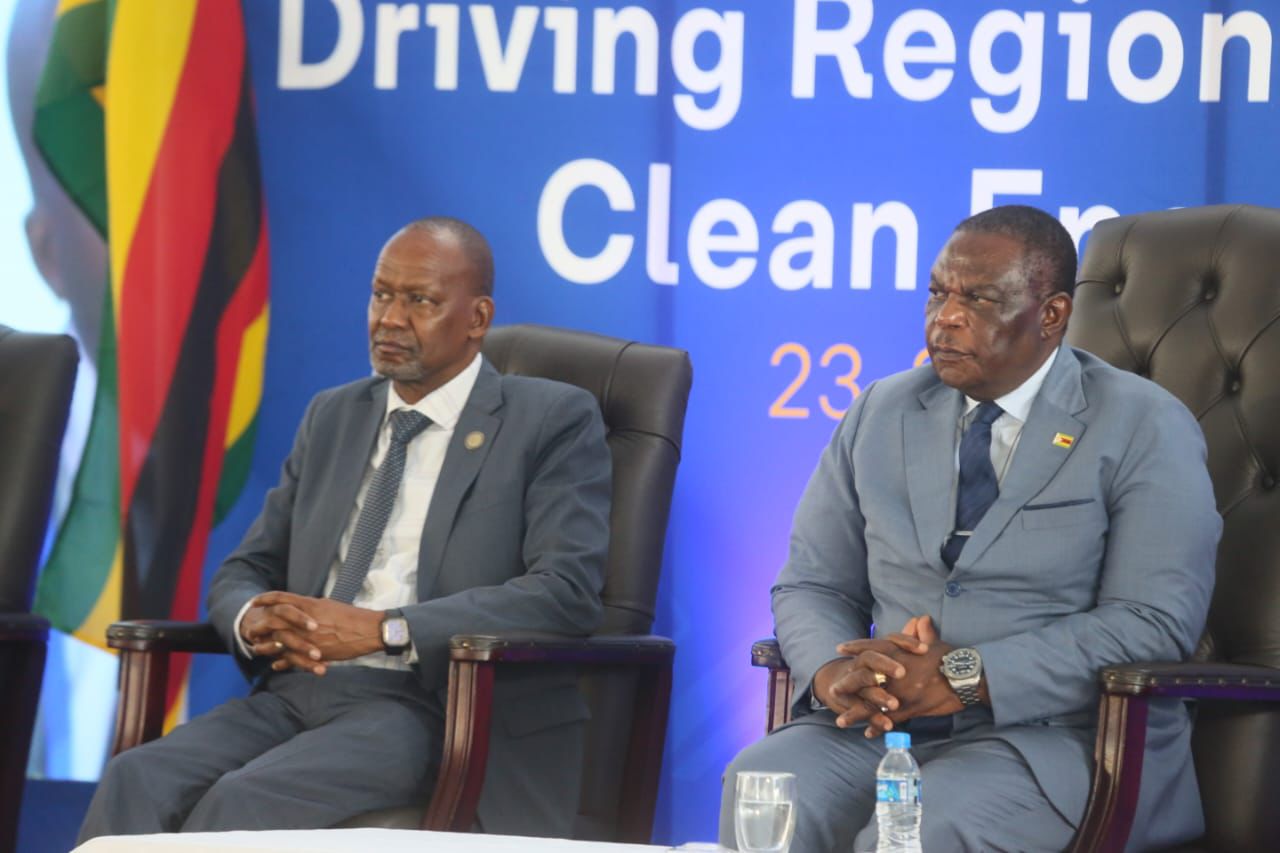
Vice President, Constantino Chiwenga, has called on Southern African nations to move decisively from energy dialogue to action, emphasizing that clean energy is a vital driver of economic growth and industrialization in the region.
Addressing delegates at the official opening of Sustainable Energy Week in Victoria Falls, today, VP Chiwenga praised Africa’s readiness to participate in the global energy transition, which he said is reshaping capital flows and supply chains.
“Capital flows are shifting and supply chains are being reconfigured, and Southern Africa must not be a spectator to this transition. We must shape it,” he said.
“The high-level convergence clearly signals one thing; the region is ready to move from dialogue to delivery.”
He outlined the persistent challenges confronting the Southern African Development Community (SADC), which include power deficits, ageing infrastructure, transmission bottlenecks, fragmented regulatory regimes, and an annual infrastructure financing gap estimated at US$83 billion, all of which continue to constrain growth, and challenged the region to rise above it.
“We possess the resources. We possess the market and the strategic geography. What is required now is execution, discipline, and investment acceleration. If we act decisively, Southern Africa can transition from energy deficit to energy surplus; from commodity exporter to industrial hub; from climate vulnerability to climate resilience. Clean energy is no longer a future aspiration, it is an immediate economic strategy,” VP Chiwenga said.
Turning to regional frameworks such as the Renewable Energy Strategy and Action Plan (RESAP), the Energy Efficiency Strategy, and the Southern African Power Pool (SAPP), he urged them to move from strategy documents to practical implementation pipelines.
“These frameworks are crucial in addressing our challenges. The time to act is now,” he said, noting that implementation would increase renewable energy share, reduce energy intensity, facilitate cross-border electricity trade, and strengthen system resilience.
Looking at Zimbabwe’s domestic energy landscape, he said electricity access stands at 62%, with rural access slightly above 20%. Under the National Development Strategy 2 and the Energy Compact, the country is expanding private sector participation, liberalizing generation, enabling direct power purchase agreements, accelerating rural electrification, and mobilizing domestic capital to achieve universal access by 2030.
VP Chiwenga highlighted Africa’s untapped renewable potential, noting that the continent possesses nearly 60% of the world’s best solar, wind, hydro, and biomass resources.
“Africa must leapfrog to clean, modern, and sustainable energy systems. The question is whether we remain an extraction zone or become a value-adding industrial hub in the clean energy sector,” he said.
He pointed to global trends showing the declining cost of renewable energy, including an 80% drop in solar PV costs over the past decade and substantial reductions in wind turbine prices.
“By 2030, Africa’s green economy could generate over 3.3 million direct and indirect jobs. Zimbabwe is already benefiting from this green wave, creating jobs in renewable energy and related sectors,” he added.
VP Chiwenga called on investors, policymakers, academia, and energy experts to collaborate, share knowledge, and build capacity.
“The time to act is now. Let us embrace clean energy and take definitive steps toward a sustainable and inclusive future,” he said, commending the SADC Centre for Renewable Energy and Energy Efficiency for its leadership in fostering regional cooperation.