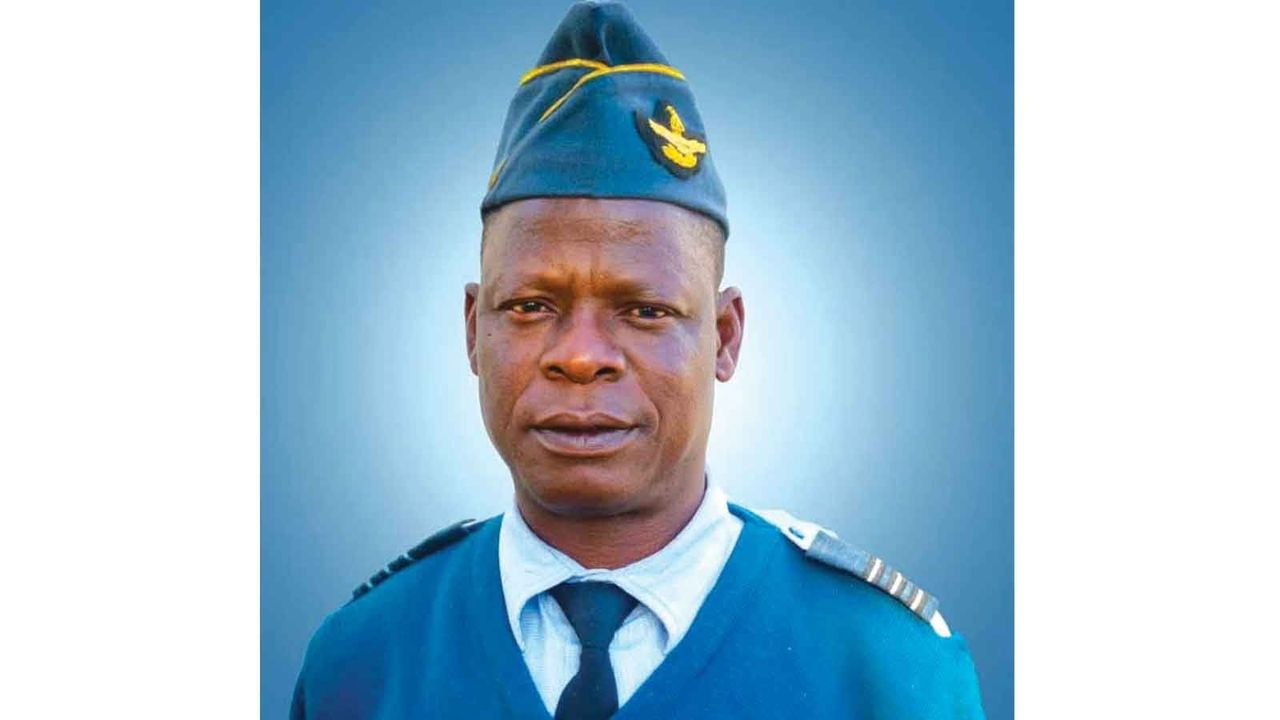
Air Commodore Simon Bere belonged to that rare generation whose lives cannot be captured fully by medals, ranks, or ceremonial tributes alone. His passing marked the end of a distinguished chapter in Zimbabwe’s military history, honoured with a full military funeral parade befitting a liberation war veteran and senior officer. Yet beyond the formal rituals of state honour lies a deeper truth a story of a man who lived at the intersection of national duty and private devotion, of war and family, of sacrifice and humility.
For the nation, Rtd Air Commodore Simon Bere stood as a symbol of disciplined service. For his family, he was something far more intimate a steady presence, a protector, and a quiet force of transformation. It is in this duality that his legacy finds its fullest meaning.
Born into the turbulence of colonial Rhodesia in 1959, Simon’s early life unfolded in a world defined by inequality and restricted opportunity. Like many young people of his generation, his path was shaped by the realities of land dispossession, racial injustice, and political exclusion. Education offered a narrow doorway to possibility, but even that required persistence and sacrifice.
His journey from rural schooling to urban education was not straightforward. It was marked by logistical challenges, financial strain, and emotional distance from home. Yet even in those early years, there was a sense that he carried within him something greater than personal ambition, a growing awareness of injustice and an emerging sense of responsibility toward his community.
That awareness would eventually lead him to a defining decision: to leave school and join the liberation struggle. It was not a choice made lightly, nor one understood immediately by those closest to him. His sudden disappearance created fear within the family, a fear shared by countless households during the liberation war, where uncertainty was often the only certainty.
In time, however, the truth emerged. Late Rtd Air Commodore Simon had crossed into Mozambique and joined the liberation forces, committing himself to the armed struggle for independence. For his family, the relief of knowing he was alive was matched by the sobering reality that he had entered a dangerous and uncertain path.
What followed was years of separation, struggle, and transformation. In the camps of the liberation movement, Rtd Air Commodore Bere matured into a disciplined cadre, shaped by ideology, hardship, and collective purpose. He adopted a Chimurenga identity, shedding his former self to become part of a broader national struggle for freedom.
The liberation war was not merely a military campaign; it was a crucible of identity. For Simon, it became the foundation upon which his sense of duty and leadership would be built. Yet even as he embraced the demands of war, he never severed the emotional thread that tied him to home.
When independence finally arrived in 1980, Simon Bere transitioned from guerrilla fighter to nation builder. He joined the Air Force of Zimbabwe in 1981, entering a new institutional landscape that demanded discipline, technical skill, and adaptability. Starting at entry level, he rose steadily through the ranks, eventually attaining the position of Air Commodore.
His career in the Air Force reflected a broader national journey the transformation of liberation structures into state institutions. In this space, Simon distinguished himself not through flamboyance, but through consistency. He specialised in explosives and ordnance, contributing to both domestic defence structures and regional peace operations, including deployments in Mozambique and the Democratic Republic of Congo.
Yet even as he served in complex operational environments, those who knew him describe a man who remained grounded. He was not defined by authority, but by responsibility. He did not seek visibility, but impact. His leadership was quiet, deliberate, and anchored in a deep sense of duty.
Beyond the military, late Rtd Air Commodore Simon Bere also engaged in national service through civilian institutions, later serving within structures supporting war veterans. In this role, he worked on programmes aimed at improving the welfare of those who had fought alongside him, ensuring that the sacrifices of the liberation struggle were not forgotten in the years of peace.
But to understand the late Simon Bere fully, one must move beyond institutions and into the realm of personal memory where his legacy is not measured in ranks, but in relationships.
To his family, he was not a distant figure defined by uniform and ceremony. He was present in small, consistent ways that left lasting impressions. He maintained contact, offered support, and remained emotionally anchored to his roots even as his professional life demanded discipline and distance.
Before he acquired the comforts of senior rank, he still made the effort to visit and check on family members, demonstrating that responsibility did not depend on convenience. These acts, though simple, carried profound meaning they reflected a man who understood that service begins at home.
For his relatives, his return from war marked a turning point. Life, once defined by hardship and manual survival, began to shift gradually as he contributed to improving living conditions. But more important than material change was the emotional reassurance of having someone who had not only survived the war but remained committed to family unity.
His journey from rural boy to national officer, from freedom fighter to institutional leader, was mirrored by a parallel journey within his household from absence to presence, from uncertainty to stability.
Even as he rose through the ranks, Simon Bere remained reluctant to speak about his wartime experiences. This silence was not absence of memory, but perhaps a reflection of discipline, an understanding that some burdens are carried rather than spoken.
His legacy was instead transmitted through values. To his children and family, he taught humility, kindness, and integrity. He encouraged resilience, self-belief, and moral grounding. These were not abstract lessons, but lived principles demonstrated through his own conduct.
In many ways, late Rtd Air Commodore Simon Bere’s life mirrors the broader story of Zimbabwe itself, a journey from colonial struggle to independence, from war to institution-building, from survival to development. His personal trajectory reflects the evolution of a nation still negotiating the meaning of its hard-won freedom.
Today, as Zimbabwe continues its pursuit of national development and economic transformation, his life offers a reminder that nation-building is not only the responsibility of governments and institutions, but also of individuals who carry values forward across generations.
His story also raises a broader question for society: how are heroes remembered? Is it through monuments and ceremonies, or through the continued reflection of the values they embodied? In the late Simon Bere’s case, the answer lies in both, but more importantly, in the lives he quietly shaped along the way.
He was a soldier who fought in war, a pilot in uniformed service, a public servant in peace, and a family man in private life. Each role reinforced the other, creating a legacy that cannot be confined to a single narrative.
As Zimbabwe reflects on his passing, the challenge is not only to honour his memory, but to reflect on what it means to live with similar integrity. His life suggests that true greatness is not loud, nor always publicly celebrated. It is often found in consistency, humility, and service without expectation of reward.
Late Bere has been laid to rest, but his story remains present, in the institutions he helped build, in the family he nurtured, and in the values he passed on. His legacy endures not only in history books or military records, but in the quiet echo of lives he touched.
In the end, he was both a hero at war and a pillar at home and it is in that balance that his true legacy resides.