
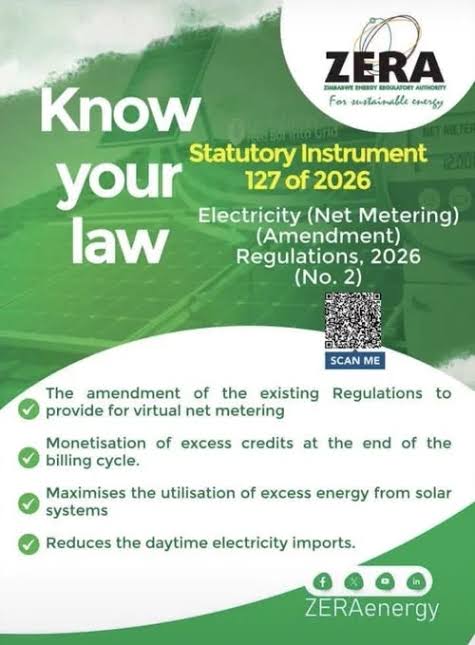
Zimbabwe has introduced virtual net metering and a framework for paying eligible electricity consumers for surplus solar power under Statutory Instrument 127 of 2026.
In a statement, yesterday, the Zimbabwe Energy Regulatory Authority (ZERA) said the amendments introduce two significant changes to the country’s electricity net metering framework.
“Zimbabwe’s Statutory Instrument 127 of 2026 introduces two significant changes to the country’s electricity net metering framework,” ZERA said.
The first amendment introduces virtual net metering, which allows eligible solar electricity credits to be transferred between approved supply points, potentially benefiting businesses and organisations operating from multiple locations.
“Eligible solar electricity credits can be transferred between approved supply points, potentially benefiting businesses operating at multiple locations,” the Authority said.
The second amendment establishes a framework for monetising surplus electricity credits accumulated during the annual billing cycle, potentially enabling eligible consumers to receive payments for excess power generated through their solar installations.
“Excess electricity credits accumulated over the annual billing cycle may become payable, subject to the applicable regulatory conditions, taxes and levies,” ZERA said.
However, the regulations do not establish a fixed purchase price for surplus electricity, meaning the amount payable for excess power will depend on the applicable regulatory arrangements rather than a predetermined rate per kilowatt-hour.
“The regulations establish a framework for monetising surplus electricity, but do not themselves establish a fixed purchase price per kWh,” the Authority said.
The development could allow businesses generating surplus solar power at one premise to use eligible electricity credits at another approved location, subject to the applicable regulatory requirements.
These changes could strengthen incentives for households and businesses to invest in solar energy by providing additional opportunities to benefit financially from electricity generated beyond their immediate consumption requirements.
The framework is expected to provide greater flexibility for eligible solar power producers while supporting the expansion of private electricity generation, subject to the conditions governing participation in the net metering system.